
How the VA Rates Depression From 0% to 100%

A VA depression disability rating is based on how service-connected depression affects your ability to work, manage daily life, and maintain relationships. Major depressive disorder is rated under Diagnostic Code 9434 and the mental-health schedule in 38 C.F.R. § 4.130.
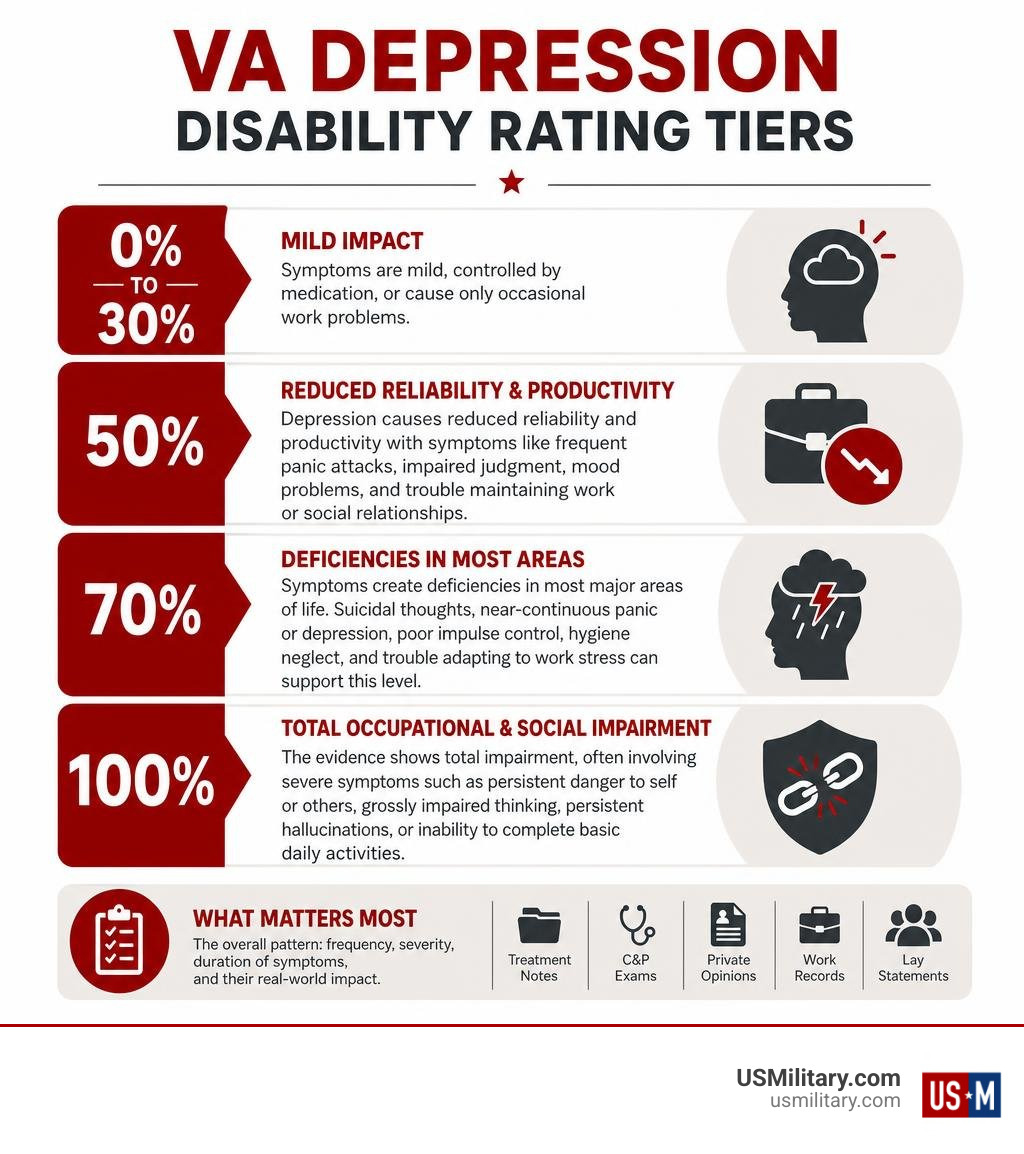
The VA uses these broad levels:
- 0% to 30%: Symptoms are mild, controlled by medication, or cause only occasional work problems.
- 50%: Depression causes reduced reliability and productivity, such as frequent panic attacks, impaired judgment, mood problems, and difficulty keeping effective work or social relationships.
- 70%: Symptoms create deficiencies in most major areas of life. Suicidal thoughts, near-continuous panic or depression, poor impulse control, hygiene neglect, and trouble adapting to work stress can support this level.
- 100%: The evidence shows total occupational and social impairment, often involving severe symptoms such as persistent danger to self or others, grossly impaired thinking, persistent hallucinations, or inability to complete basic daily activities.
The listed symptoms are examples, not a checklist. What matters most is the overall pattern: the frequency, severity, and duration of symptoms, plus their real-world impact. Treatment notes, C&P exams, private opinions, work records, and statements from people who see your daily struggles can all help show that impact.
I am LARRY FOWLER, BUD/S Class 89, publisher of NavySeal.com and the USMilitary.com Network, which has helped military members and veterans navigate VA benefits trends since 2007. In this guide, I will break down the VA depression disability rating standards in plain language and explain what evidence can strengthen a claim.
Glossary for VA depression disability rating:
Overview of the VA Depression Disability Rating Schedule and Diagnostic Code 9434
When evaluating service-connected clinical depression, the Department of Veterans Affairs relies on the General Rating Formula for Mental Disorders outlined in 38 C.F.R. § 4.130. Major Depressive Disorder (MDD) is formally categorized under Diagnostic Code 9434.
Adjudicators do not simply tally individual symptoms like items on a grocery receipt. Under established legal precedents such as Mauerhan v. Principi, the VA must perform a holistic symptom analysis. This means the raters examine how your total psychiatric picture diminishes your occupational and social capacity. The symptoms listed in the rating schedule serve as general illustrations of impairment levels rather than mandatory requirements.
Whether your diagnosis is major depressive disorder, persistent depressive disorder (dysthymia), or depression with anxious distress, the VA uses this unified formula to assign a percentage. Exploring the VA rating for depression helps you understand how different clinical diagnoses map directly onto the same statutory rating table.
Step-by-Step VA Depression Disability Rating Breakdown from 0% to 100%
The mental health rating schedule is tiered into distinct percentages: 0%, 10%, 30%, 50%, 70%, and 100%. Each tier represents a specific degree of occupational and social impairment.
| Rating Level | Legal Impairment Standard | Example Clinical Symptoms |
|---|---|---|
| 0% | Diagnosed condition with no functional impairment | Symptoms not severe enough to interfere with work or social life or require continuous medication. |
| 10% | Mild or transient impairment | Work efficiency decreases only during periods of significant stress; or symptoms are fully controlled by continuous medication. |
| 30% | Occasional decrease in work efficiency | Intermittent inability to perform occupational tasks; mild memory loss; panic attacks occurring weekly or less frequently; chronic sleep impairment. |
| 50% | Reduced reliability and productivity | Flattened affect; panic attacks more than once a week; impaired judgment; disturbances of motivation and mood; difficulty maintaining effective relationships. |
| 70% | Deficiencies in most areas | Suicidal ideation; near-continuous panic or depression; impaired impulse control (e.g., unprovoked irritability or outbursts); neglect of hygiene; inability to adapt to stressful settings. |
| 100% | Total occupational and social impairment | Grossly impaired thought processes or communication; persistent delusions or hallucinations; disorientation to time/place; persistent danger of hurting self or others. |
To see how these individual percentages combine with other service-connected physical disabilities, consult our VA disability rating chart guide 2026. Furthermore, you can track updated monthly payment amounts across all family composition tiers via our overview of 2026 VA disability rates.
Evaluating the Critical Jump: 50% vs. 70% Rating Thresholds
The transition between a 50% and a 70% evaluation represents the most contentious boundary in VA mental health adjudication.
A 50% rating reflects "reduced reliability and productivity." A veteran at this level might hold a job but frequently call out sick, struggle with mood swings, experience weekly panic attacks, or find it difficult to collaborate with coworkers.
In contrast, a 70% evaluation requires evidence of "deficiencies in most areas" such as work, school, family relations, judgment, thinking, or mood. Symptoms that commonly substantiate a 70% rating include:
- Suicidal ideation: Both active suicidal planning and passive suicidal ideation (such as wishing not to wake up) are legally recognized as serious symptoms under Bankhead v. Shulkin.
- Impaired impulse control: Frequent unprovoked irritability, angry outbursts, or episodes of physical/verbal violence that alienate supervisors, coworkers, or family members.
- Severe neglect of personal hygiene: Going days without showering, changing clothes, or brushing teeth due to overwhelming depressive lethargy.
- Near-continuous panic or depression: Emotional paralysis that prevents you from adapting to routine workplace changes or social demands.
Veterans frequently ask what is the VA disability rating for depression and anxiety? to determine how co-occurring panic or generalized anxiety influences this critical jump to 70%.

Key Evidence Required for High-Tier Depression Ratings and TDIU
Securing a high-tier rating (70% or 100%) requires consistent objective and subjective evidence demonstrating functional loss over time.

Medical Records, GAF Scores, and Lay Statements
A successful claim relies on a balance of clinical and real-world behavioral documentation:
- Clinical Treatment Records: Consistent VA or private therapy progress notes and pharmacy refill histories establish the chronicity and severity of your condition.
- Global Assessment of Functioning (GAF) Scores: While the DSM-5 transitioned away from GAF scores, historical and private records containing GAF scores remain relevant evidence in VA appeals. Scores between 41 and 50 reflect serious symptoms (such as suicidal ideation or inability to keep a job), while scores between 31 and 40 signify major impairments in reality testing, communication, or multiple life areas.
- Lay Statements and Buddy Letters: Detailed statements from spouses, family members, or former coworkers carry significant probative value. A spouse describing how you isolate in a dark room for four days straight or neglect personal hygiene provides functional evidence that clinical questionnaires might miss.
Under 38 U.S.C. § 5107(b) and 38 C.F.R. § 3.102, the VA must apply the benefit-of-the-doubt doctrine. When the positive and negative evidence regarding disability severity is in approximate balance (equipoise), the VA is legally required to resolve reasonable doubt in your favor and assign the higher rating. For those seeking immediate assistance or counseling, our guide on mental health resources for military veterans provides essential support links. Detailed filing steps are also accessible through the complete guide to VA disability claims.
Total Disability Based on Individual Unemployability (TDIU) at 70%
Veterans who are granted a 70% rating for depression but cannot maintain employment often do not need to meet the extreme clinical threshold of a 100% schedular rating. Instead, they can apply for Total Disability based on Individual Unemployability (TDIU) under 38 C.F.R. § 4.16(a).
Schedular TDIU requires:
- One service-connected disability rated at 60% or higher, OR
- A combined rating of 70% or higher with at least one disability rated at 40% or higher.
A single 70% depression rating satisfies this requirement on its own. To establish entitlement, you must submit VA Form 21-8940 (Veteran's Application for Increased Compensation Based on Unemployability) alongside evidence demonstrating that your psychiatric symptoms—such as panic attacks, severe lack of motivation, memory impairment, or angry outbursts—prevent you from securing or following a substantially gainful occupation.
Receiving TDIU pays you at the 100% disability compensation rate. You can review current monthly financial figures using the VA disability pay chart 2026.
Secondary Service Connection, Staged Ratings, and Appeals
Many veterans develop depression as a secondary consequence of service-connected physical injuries, or develop new physical ailments due to their psychiatric treatments.

Secondary Conditions and Medication Side Effects
If your primary service-connected condition (such as chronic back pain, tinnitus, or joint injuries) causes depression, you can claim VA disability for depression on a secondary basis.
Conversely, long-term prescription treatments for depression can cause compensable secondary physical conditions. For instance, the Board of Veterans' Appeals has granted secondary service connection for cataracts resulting from long-term psychiatric medications (such as oxcarbazepine), as well as secondary hypertension aggravated by chronic psychiatric distress.
If you suffer from overlapping psychological symptoms, exploring your anxiety VA rating options ensures all facets of your mental health are properly presented to the VA rating board. Learn more about broad schedule categories by reviewing VA disability ratings.
How to Request an Increased VA Depression Disability Rating
If your depression has worsened since your last decision, you have several options under the Appeals Modernization Act (AMA):
- Supplemental Claim (VA Form 20-0995): File this if you have "new and relevant" evidence, such as recent private psychological evaluations, updated medication lists, or fresh lay statements.
- Board of Veterans' Appeals (VA Form 10182): If you believe the regional office made an error, you can appeal directly to a Veterans Law Judge via the Direct Review, Evidence Submission, or Hearing lanes. That the Direct Review lane restricts the Board to evidence present in your record at the time of the appealed rating decision.
- Continuous Pursuit and Effective Dates: Under 38 C.F.R. § 3.156(c), submitting newly discovered service records or timely appealing within one year keeps your claim active, preserving an earlier effective date for retroactive compensation.
For practical steps on reopening or appealing a claim, read our walkthrough on how to increase my VA disability rating and start the process to file VA disability.
Frequently Asked Questions About VA Ratings for Depression
Can you get a 100% rating for depression without hallucinations or delusions?
Yes. Under Mauerhan v. Principi, the symptoms listed under the 100% rating level in 38 C.F.R. § 4.130 (such as persistent hallucinations, gross impairment in thought processes, or persistent danger to self/others) are illustrative rather than mandatory. However, achieving a 100% schedular rating requires evidence of total occupational and social impairment. If a veteran maintains a job or has healthy social and family relationships, the VA will rarely assign a 100% schedular evaluation, making TDIU the more viable route for those unable to work.
How does the VA handle overlapping symptoms between depression and PTSD?
The VA avoids "pyramiding" (assigning separate ratings for the same symptom under 38 C.F.R. § 4.14). If you are diagnosed with both depression and PTSD, the VA will typically combine them into a single service-connected mental health evaluation (e.g., "major depressive disorder with PTSD"). For details on trauma-specific evaluations, review our guides on the VA disability rating for PTSD and PTSD VA disability rating.
What happens if depression symptoms worsen during an appeal?
Under the legal precedent Fenderson v. West, the VA can assign staged ratings. If your depression was evaluated at 50% during the initial filing period but medical evidence shows it escalated to 70% severity later in the appeal, the VA will award 50% for the earlier period and 70% from the date your symptoms worsened.
Conclusion
Understanding how the VA rates major depressive disorder under Diagnostic Code 9434 is essential to ensuring you receive the full compensation you have earned. Focus on documenting the frequency, severity, and functional impact of your symptoms across your personal and professional life.
To explore all aspects of your veteran benefits, check your VA disability benefits eligibility or browse our central hub for VA benefits guidance. If you need comprehensive information on military career paths, loans, and benefits, our homepage at USMilitary.com is here to support you every step of the way. For spiritual encouragement and resilience on your journey, consider exploring Dare to Live Greatly.