Spot a Navy SEAL by Habits, Not Hollywood Looks

The best way to spot a possible Navy SEAL is to notice low-key habits, not muscles, tattoos, or loud military gear. Look for someone who chooses a seat with a clear view of the room, stays calm in a busy setting, notices exits without making a show of it, and wears practical, unbranded clothing.
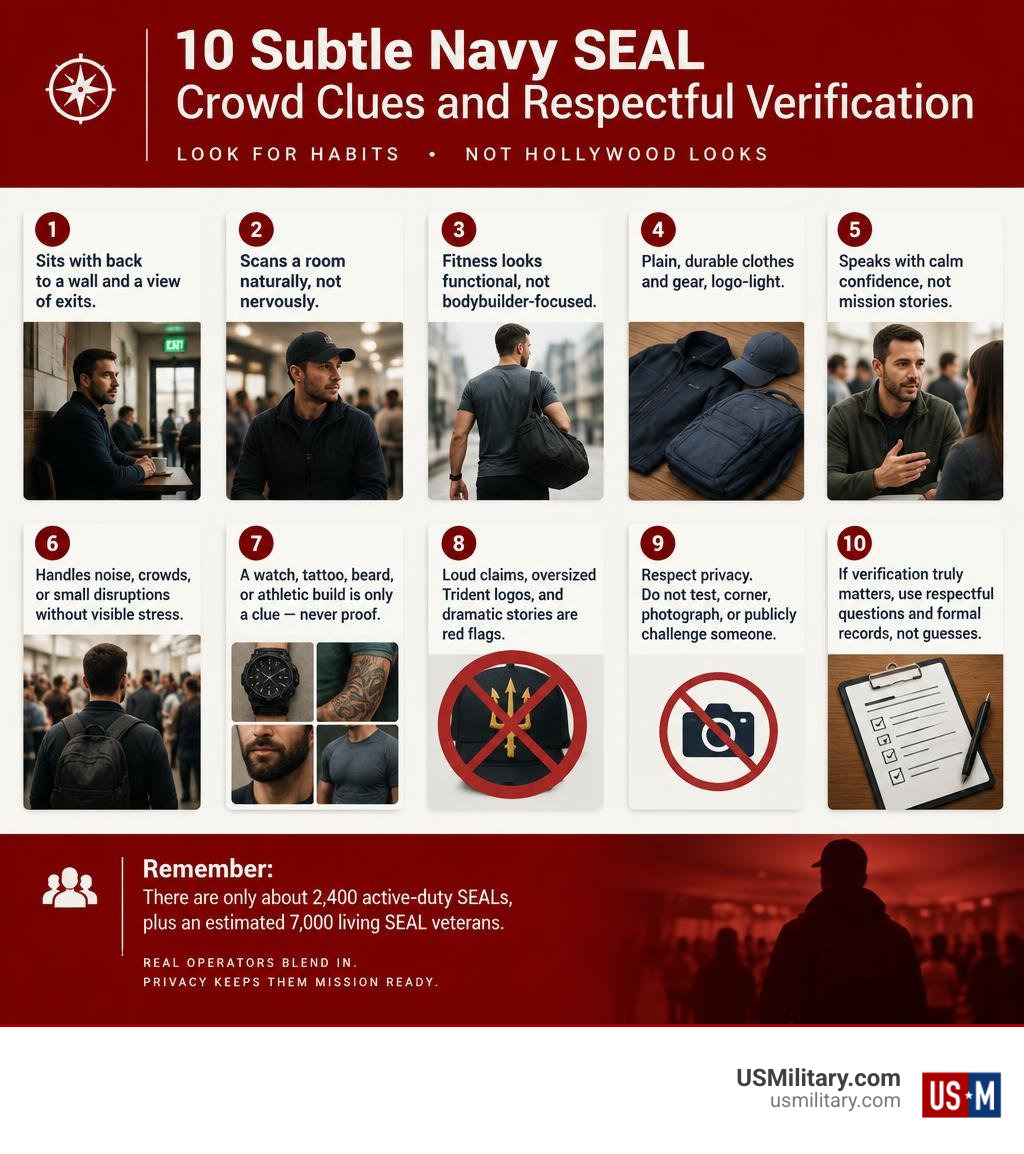
Here are the quick clues behind 10 Tips on how to Spot A Navy SEAL In A Crowded Room:
- They may sit with their back to a wall and a view of exits.
- They often scan a room naturally, not nervously.
- Their fitness tends to look functional rather than bodybuilder-focused.
- Their clothes and gear are usually plain, durable, and logo-light.
- They tend to speak with calm confidence, not mission stories.
- They may handle noise, crowds, or small disruptions without visible stress.
- A watch, tattoo, beard, or athletic build is only a clue - never proof.
- Loud claims, oversized Trident logos, and dramatic stories are stronger signs of an impostor than a real operator.
- Respect privacy. Do not test, corner, photograph, or publicly challenge someone.
- If verification truly matters, use respectful questions and formal records rather than guessing.
There are only about 2,400 active-duty SEALs, plus an estimated 7,000 living SEAL veterans, so the odds that any stranger is a SEAL are small. Real operators are often called quiet professionals for a reason: blending in protects privacy, supports operational security, and reflects a culture that values team performance over personal attention.
I am LARRY FOWLER, BUD/S Class 89, publisher of NavySeal.com and the USMilitary.com Network since 2007, serving readers who need clear information about military careers, service, and veteran issues. In this guide to 10 Tips On How To Spot A Navy SEAL In A Crowded Room, I will help you separate fun observations from real evidence while keeping respect and discretion first.
Simple 10 Tips On How To Spot A Navy SEAL In A Crowded Room Glossary:
- Navy SEALs Complete Guide
- How Navy SEALs Can Be Perfect Husbands and Amazing Role Models
- Who is Navy SEAL, David Goggins
The Reality of Identifying Operators: The Quiet Professional Mindset
When Hollywood portrays elite maritime commandos, we often see massive action stars kicking down doors in full tactical kit. In the real world, genuine operators live by an entirely different creed: the "Quiet Professional." Their goal in civilian life is never to draw eyes, invite questions, or advertise their lethal capabilities. Instead, operational security (OPSEC) and cultural humility guide how they move through everyday spaces. To gain a deeper understanding of this ethos, explore our comprehensive guide to the US Navy SEALs.
This mindset is rooted in practical survival and mission discipline. Operators know that standing out makes them a target and compromises privacy for their families and teammates. When they walk into an airport lounge, a crowded diner, or a coffee shop, their tactical instinct is to apply a camouflage mindset to ordinary civilian life.
Statistical Rarity and the Gray Man Concept
It is essential to keep the numbers in perspective. As of September 2026, there are only about 2,400 active-duty Navy SEALs serving across the entire United States. When you add roughly 7,000 living SEAL veterans, you are looking at fewer than 10,000 individuals in a nation of over 330 million people. That means only about 1 out of every 45,000 Americans has earned the coveted Special Warfare insignia (the Trident).
Because of this statistical rarity, the odds of crossing paths with an operator on any given afternoon are minuscule. When you do encounter one, they will almost certainly be practicing the "Gray Man" concept. This discipline involves:
- Dressing in neutral, unremarkable clothing that matches the regional baseline.
- Moving smoothly without drawing attention or invading personal space.
- Masking elite capabilities behind standard civilian routines.
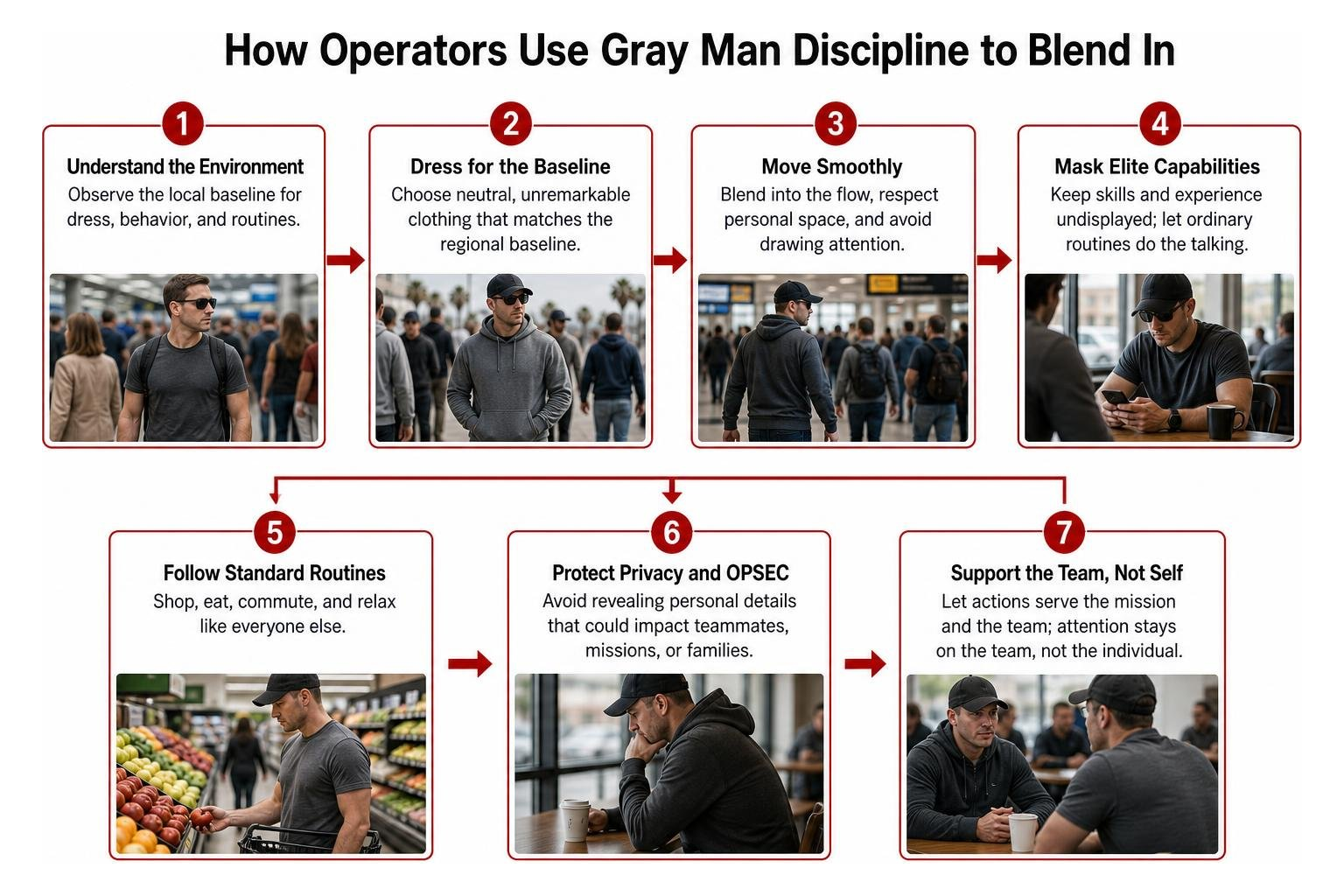
Why Spotting SEALs Is Hardest in Base Towns
You might assume that walking into a bar or gym in Coronado, California, or near Joint Expeditionary Base Little Creek in Virginia Beach, Virginia, makes spotting an operator simple. In truth, these military hubs are the hardest places to pick them out.
In coastal naval hubs, functional fitness, weather-beaten complexions, tactical watches, and unbranded athletic wear represent the community baseline. When thousands of active-duty personnel, rescue swimmers, divers, and competitive triathletes share the same grocery aisles, the subtle traits of a SEAL blend into everyday coastal living. Furthermore, local culture in these base towns actively respects operator privacy, creating a shield of community discretion where nobody points, stares, or pries.
10 Fun Tips On How To Spot A Navy SEAL In A Crowded Room

Spotting an elite operator is not about hunting for dramatic movie tropes; it is about recognizing deep-seated habits formed through world-class conditioning. As detailed in expert training insights from a Navy SEAL officer, the traits forged during military service stick with personnel long after they step off the battlefield.
Here are the 10 fun, practical tips broken down by behavioral habits and physical cues.
Observational and Behavioral Habits: 10 Fun Tips On How To Spot A Navy SEAL In A Crowded Room
1. Tactical Seating (The Corner Anchor)
When entering a restaurant, bar, or meeting space, a SEAL will rarely take a center table with their back exposed to the main entryway. Instinctively, they choose a seat positioned against a solid wall or corner. This tactical seating habit provides an unobstructed panoramic view of the room, main entrances, and secondary corridors without turning their head constantly.
2. Passive Exit Scanning and Situational Baseline
Watch how people enter a room. Most civilians stare directly at their smartphones or shuffle forward in a daze. An operator performs a rapid, fluid environmental scan within five seconds of walking through the threshold. They subconsciously identify:
- Primary and secondary emergency exits.
- Choke points and structural cover options.
- Outliers—individuals displaying agitated, nervous, or erratic body language.
They do not look frantic or paranoid; their baseline scanning looks relaxed and natural.
3. Deep Composure and Stress Inoculation
Whether an espresso machine shrieks, a glass shatters on the floor, or a sudden verbal argument erupts, notice who stays utterly unflappable. Elite operators undergo relentless stress inoculation during Navy SEAL daily life and demanding BUD/S training phases. Because their nervous systems have been tested against life-or-death pressures, sudden minor civilian disruptions barely register on their heart rates.
4. Grounded, Deliberate Body Language
A genuine operator carries a posture of quiet confidence. They stand tall with their weight balanced evenly on the balls of their feet, ready to pivot or move. They move through tight crowds with fluid economy, never bumping into others or making jerky, wasteful movements. Their eye contact is direct, warm, and attentive, yet completely devoid of posturing or aggression.
5. Dry Wit and Conversational Humility
If you overhear an operator chatting, you will not hear boastful war stories or self-aggrandizing claims. Their communication is typically succinct, humble, and heavily laced with dry, dark humor. Operators rely on dark humor and positive internal self-talk to survive brutal physical trials where only one in five candidates completes the underwater "pool comp" exercise on the first attempt. When asked about their military service, they often downplay their role, stating simply, "I was in the Navy," or "I worked support on the West Coast."
Physical Build and Gear Clues: 10 Fun Tips On How To Spot A Navy SEAL In A Crowded Room
6. Functional V-Shaped Fitness Over Bodybuilder Bulk
Forget the comic-book stereotype of a 275-pound bodybuilder who can barely scratch his own back. SEAL operational fitness requires extreme cardiovascular endurance, tactical mobility, and high strength-to-weight ratios. The typical operator build features:
- A dense, athletic V-shaped torso with broad shoulders and a lean waist.
- Powerful trapezius and upper-back muscles developed from swimming with fins, ocean rucking, and combat loads.
- Highly conditioned legs built for endurance rather than purely aesthetic quad volume.
To see how extreme endurance fitness shapes an operator, look at the discipline outlined in the Navy SEAL endurance guide.
7. The Inward-Facing Tactical Timepiece
Look at the wrist. Many active and veteran operators wear durable, high-utility digital or dive watches (such as Garmin, Suunto, Luminox, or Casio G-Shock). You may notice the watch face turned inward on the inside of the wrist. In tactical operations, wearing a watch face-inward prevents light reflection that could give away a position, protects the crystal face against weapon impacts, and allows the wearer to check mission timing while holding equipment.
8. Subdued, Logo-Free Quality Apparel
Real SEALs rarely wear civilian clothing emblazoned with military slogans, giant skull logos, or camouflage patterns in public. Instead, their wardrobe choices prioritize functional utility:
- Durable, unbranded earth-tone fabrics (canvas, ripstop, merino wool, high-performance denim).
- Premium, trail-tested footwear (Salomon, Lowa, Arc'teryx, or Vans) offering maximum traction and agility.
- Low-profile EDC (Everyday Carry) knives or flashlights clipped cleanly inside pockets without fanfare.
9. Grooming Flexibility and the "Modified Civilian" Look
Because operational detachments often deploy to austere environments requiring local cultural integration, active-duty SEALs are frequently granted relaxed grooming standards. While conventional naval personnel maintain strict high-and-tight haircuts and clean-shaven faces, an active operator may sport a well-maintained full beard, longer hair, and a weathered complexion from salt water and sun, all while maintaining strict military posture.
10. Subtle Maritime Tattoos (The Bone Frog)
While you will almost never see an active SEAL walking around in a shirt stamped with a gold Trident, you might spot meaningful, understated ink. One of the most revered symbols among naval special warfare personnel is the "Bone Frog"—a skeletal frog tattoo that pays tribute to the original Underwater Demolition Teams (UDT) and fallen brothers. These tattoos are usually placed discreetly on the inner bicep, ribs, or shoulder blade, visible only in passing.
To explore more about official operational qualifications and requirements, review official Navy SEAL career duties.
Separating Real Operators from Impostors
Unfortunately, the elite reputation of the SEAL Teams attracts individuals who fabricate military service. Stolen valor is remarkably common; some military researchers estimate that for every authentic living SEAL, there may be as many as 300 impostors claiming the title in bars, online forums, and civilian workplaces.
Understanding the untold secrets of Navy SEALs and the rigorous standards that separate naval commandos from other branches—such as our breakdown on training comparison with Army Rangers—makes spotting an impostor straightforward.
Common Stolen Valor Red Flags
Impostors rely on civilian ignorance and dramatic exaggerations. When someone wants you to believe they are an elite commando, they almost always violate the quiet professional code.
| Feature / Trait | Genuine Navy SEAL | Stolen Valor Impostor |
|---|---|---|
| Conversational Style | Quiet, humble, deflects personal attention to team | Boastful, loud, insists on telling high-stakes combat tales |
| Wardrobe & Badges | Unbranded, practical civilian clothing | Wears oversized Trident pins, military patches, or tactical camo out of context |
| Mission Details | Protects OPSEC; speaks vaguely about locations | Claims "classified black-ops missions" that they somehow disclose freely |
| BUD/S Details | Readily names class number, instructors, and training base | Stumbles on training timeline, class number, or training details |
| Physical Demeanor | Relaxed, composed, functionally fit | Aggressive, dramatic posturing, often lacking functional fitness |
Practical Verification Tactics and Questions
If you are evaluating a suspicious claim in a business, charitable, or formal setting, you do not need to stage an aggressive confrontation. Simple, targeted questions will immediately reveal whether someone has spent time on the grinder at the Naval Special Warfare Center in Coronado:
- "What BUD/S class were you in?" Every single Navy SEAL knows their Basic Underwater Demolition/SEAL (BUD/S) class number instantly. Over 330 classes have graduated over the decades, and that number is etched into an operator’s identity for life.
- "Which side of the grinder is the BUD/S bell located on?" Anyone who spent six months enduring Hell Week and physical training knows the exact layout of the Naval Special Warfare compound in Coronado.
- "Did you dive the Draeger or the LAR V rebreather during Second Phase?" Real operators spent dozens of hours mastering closed-circuit underwater diving apparatuses and can talk comfortably about the gear.
For complete, irrefutable verification in legal, corporate, or charitable contexts, records can be verified through formal Freedom of Information Act (FOIA) requests submitted to the National Personnel Records Center (NPRC) or authenticated through verified veteran databases maintained by authentic SEAL associations.
Respectful Etiquette and Public Ethics

If you happen to recognize the subtle behavioral signs of a Navy SEAL in a public place, spotting an operator should never lead to invading their personal space.
Operators value their personal downtime with family and friends. Walking up to a stranger to demand proof of service, asking about combat encounters, snapping unauthorized photos, or drawing loud public attention compromises their privacy and creates awkwardness.
The best etiquette is simple and understated:
- The Subtle Nod: A brief, respectful nod of acknowledgment conveys gratitude without requiring an uncomfortable public conversation.
- Respect the Boundary: Never ask an operator about classified missions or combat trauma.
- Keep Discretion First: If you are introduced to an operator through mutual friends, allow them to set the depth of the conversation.
Frequently Asked Questions About Spotting Navy SEALs
Do active-duty Navy SEALs wear Trident pins on civilian clothes?
No. Active-duty SEALs almost never wear their gold Special Warfare insignia on civilian jackets, shirts, or hats. The gold Trident is reserved strictly for official Navy dress and service uniforms. Wearing Trident lapel pins or oversized patches on civilian attire is usually done by enthusiastic family supporters or impostors seeking attention.
How many active-duty Navy SEALs are there in the United States?
There are roughly 2,400 active-duty Navy SEALs serving worldwide across East Coast and West Coast SEAL Teams, SEAL Delivery Vehicle (SDV) Teams, and special development units. Alongside roughly 7,000 living veterans, they represent an extraordinarily small fraction of the military community.
Where are you most likely to encounter a Navy SEAL?
The highest concentration of active and former SEALs is found near their primary operational command hubs:
- Coronado and San Diego, California (Naval Special Warfare Command and West Coast Teams).
- Virginia Beach and Norfolk, Virginia (Little Creek and East Coast Teams).
- Advanced training sites in Florida, Hawaii, and Kodiak, Alaska.
Outside of these hubs, operators frequently participate in outdoor endurance sports, triathlons, backcountry hunting, and maritime diving expeditions.
Conclusion
Spotting a Navy SEAL in everyday life is less about looking for an intimidating Hollywood soldier and more about noticing the quiet, disciplined habits of an elite professional. From their corner seating choices and calm situational awareness to functional athleticism and understated wardrobe, real operators let their competence speak through their actions rather than loud words.
At USMilitary.com, we are proud to honor our nation's service members across every branch of the Armed Forces. Whether you are exploring special operations career paths, navigating your military retirement benefits, or verifying service records, we are here to provide clear, reliable guidance. To learn everything about the rigorous journey from civilian recruit to elite special operator, dive into the USMilitary.com complete Navy SEAL guide.