10 Navy SEAL Veterans With Paths to the Presidency
The Only Easy Day Was Yesterday: BUD/S Class 89
Tim Sheehy, Ryan Zinke, Dan Crenshaw, Morgan Luttrell, Derrick Van Orden, Eli Crane, John McGuire, William H. McRaven, Jonny Kim, and Jocko Willink are 10 former Navy SEALs worth watching as possible future presidential candidates. Sheehy serves in the Senate, several others have won House seats, and the rest have led major military or civilian organizations. This is not a list of declared candidates.
SEAL service can show how someone leads under pressure. It does not, on its own, show how they would govern. This guide looks at each veteran's public record and the experience they could bring to a national campaign.
I'm Larry Fowler, BUD/S Class 89, publisher of NavySeal.com and the USMilitary.com Network, which has covered military careers and veteran resources since 2007. In this guide to 10 Veteran Navy SEALs Who Could Be President of the US, I'll start with what their service can tell us about leadership, then look at each person's path beyond the Navy.
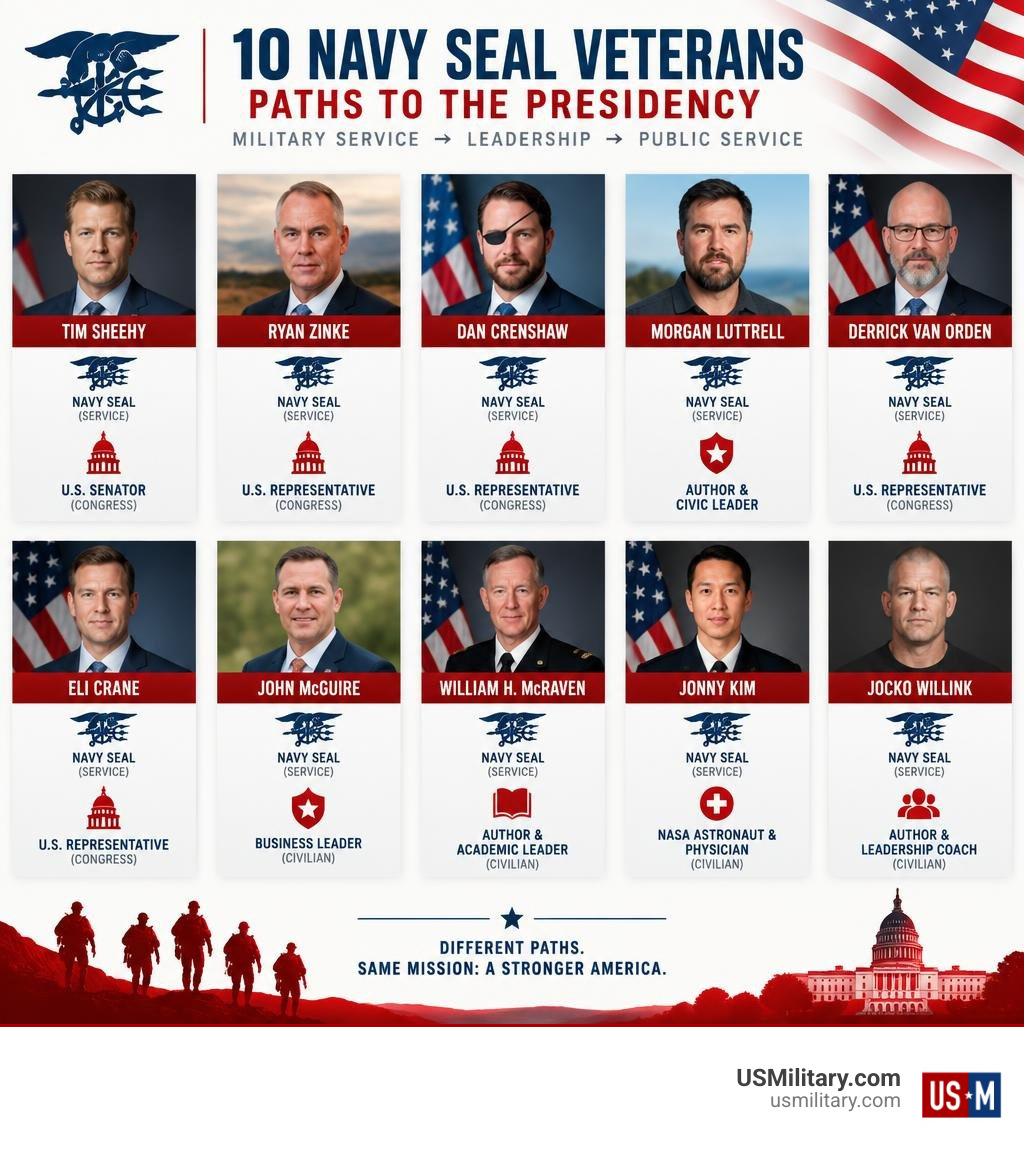
Easy 10 Veteran Navy SEALs Who Could Be President word list:
15 Navy SEALs Who Impacted America
Why Special Operations Experience Translates to Executive Command
The American presidency demands steady crisis management, rapid decision-making, and deep strategic vision under constant public scrutiny. For decades, military experience served as the bedrock of presidential readiness—from George Washington and Dwight D. Eisenhower to John F. Kennedy and George H.W. Bush. In recent years, a new generation of leaders forged in the elite ranks of Naval Special Warfare has stepped into the national arena.
According to a Politico analysis of SEALs in Congress, former special operators have established a distinct and influential voting bloc in Washington. The skills required to lead special reconnaissance teams, conduct high-stakes counterterrorism operations, and manage complex cross-functional battlefield units directly mirror the core responsibilities of executive governance.
Naval Special Warfare training weeds out roughly 75% to 80% of candidates during Basic Underwater Demolition/SEAL (BUD/S) training. Those who graduate and lead operational platoons must master high-stress communication, operational risk management, and decentralized execution. In civilian governance, these attributes provide a solid foundation for managing cabinet departments, directing foreign policy, and serving as Commander-in-Chief.
| Executive Responsibility | Military Operational Command Parallel | Core Skill Applied |
|---|---|---|
| National Security Strategy | Multi-theater deployment planning & joint-force integration | Geopolitical threat analysis & resource allocation |
| Crisis Management | Real-time tactical problem solving under direct fire | Emotional control & rapid contingency execution |
| Cabinet & Agency Oversight | Directing multi-disciplinary task forces & joint commands | Decentralized leadership & operational accountability |
| Foreign Diplomacy | Foreign Internal Defense (FID) & partner force advising | Cross-cultural negotiation & coalition building |
| Legislative Negotiation | Inter-service coordination & mission deconfliction | Strategic compromise & mission-first focus |
Critical Leadership Traits of 10 Veteran Navy SEALs Who Could Be President
The qualities that define elite combat leadership provide clear advantages in national executive campaigns:
- Extreme Ownership: The operational discipline to take full responsibility for institutional failures and mission outcomes without deflecting blame.
- Operational Resilience: Mental fortitude developed through grueling physical selection, combat tours, and high-consequence environments.
- Decisive Leadership: The ability to make rapid, pragmatic decisions with incomplete information in volatile scenarios.
- Geopolitical Awareness: Firsthand operational experience in critical theaters across the Middle East, the Indo-Pacific, and Eastern Europe.
- Constitutional Defense: A demonstrated, lifelong commitment to the oath of defending the United States Constitution.

Navy SEALs Who May Have The Leadership Skills That Lead To The White House
Below is an extensive examination of 10 distinguished Navy SEAL veterans who possess the background, leadership record, and national profile to contend for executive office.
1. Tim Sheehy: Aerial Firefighting Founder to the US Senate
Tim Sheehy represents a modern fusion of decorated combat heroism, entrepreneurial success, and high-profile statewide electoral victory. A graduate of the United States Naval Academy, Sheehy served as a Navy SEAL officer and deployed to Iraq, Afghanistan, South America, and the Pacific. During his military service, he earned the Bronze Star with Valor for heroism in combat and the Purple Heart after being wounded in action.
After retiring from the Navy for medical reasons, Sheehy founded Bridger Aerospace in Montana and grew it into an industry-leading aerial firefighting and aerospace technology enterprise. His business acumen and operational discipline propelled him into statewide politics, culminating in his election to the United States Senate representing Montana.
As a senator, Sheehy combines private-sector executive experience with national defense expertise. His legislative focus centers on fiscal restraint, domestic energy security, modernizing military procurement, and improving rural veteran healthcare. His profile as a combat-decorated veteran, job-creating CEO, and statewide elected official positions him as a natural prospect for future national executive tickets.
- Military Rank/Service: SEAL Officer (2008–2019)
- Major Honors: Bronze Star with Valor, Purple Heart
- Current/Past Office: U.S. Senator from Montana; Founder & Former CEO of Bridger Aerospace
- Key Policy Areas: Defense modernization, energy independence, small-business growth, veteran affairs
2. Ryan Zinke: Former Cabinet Secretary and Senior Lawmaker
Ryan Zinke made history as the first Navy SEAL elected to the United States House of Representatives and later became the first to serve in a presidential cabinet. Zinke served for 23 years in Naval Special Warfare (1986–2008), retiring at the rank of Commander. His military career included leading a team within the elite Naval Special Warfare Development Group (SEAL Team SIX) and serving as the ground commander for Joint Special Operations Task Force Arabian Peninsula during Operation Iraqi Freedom.
After his military retirement, Zinke served in the Montana State Senate before winning election to the U.S. House of Representatives. In 2017, he was confirmed as the 52nd United States Secretary of the Interior, overseeing an agency of over 70,000 employees and managing 500 million acres of federal public lands.
Zinke returned to the U.S. House to represent Montana's 1st Congressional District, where he sits on the House Appropriations Committee and Foreign Affairs Committee. Zinke's unique combination of senior military command, federal cabinet executive leadership, and deep legislative experience gives him a comprehensive executive pedigree.
- Military Rank/Service: Commander (O-5), U.S. Navy SEALs (1986–2008)
- Major Honors: Two Bronze Stars for meritorious service in combat
- Current/Past Office: U.S. Representative (MT-01); Former U.S. Secretary of the Interior
- Key Policy Areas: Public lands management, resource development, national defense appropriations, foreign affairs
3. Dan Crenshaw: Intelligence Leader and Foreign Policy Strategist
Dan Crenshaw emerged as one of the most visible veteran voices in national politics following his election to Congress in 2018. Crenshaw served for a decade as a Navy SEAL officer, completing five international deployments. In 2012, during his third deployment in Helmand Province, Afghanistan, he was struck by an improvised explosive device (IED) blast, losing his right eye and suffering severe damage to his left. Following intensive surgeries, he regained his sight and deployed two more times before medically retiring at the rank of Lieutenant Commander.
Holding a Master in Public Policy from Harvard University's Kennedy School of Government, Crenshaw represents Texas's 2nd Congressional District. In Congress, he serves on the House Permanent Select Committee on Intelligence and the Committee on Energy and Commerce.
Crenshaw is recognized for his detailed grasp of complex defense strategy, foreign policy, and domestic healthcare reform. His ability to articulate conservative principles across mainstream and digital media formats gives him significant national reach and fundraising capability.
- Military Rank/Service: Lieutenant Commander (O-4), U.S. Navy SEALs (2006–2016)
- Major Honors: Two Bronze Stars (one with Valor), Purple Heart, Navy and Marine Corps Commendation Medal with Valor
- Current/Past Office: U.S. Representative (TX-02)
- Key Policy Areas: Intelligence operations, counterterrorism, free-market healthcare reform, energy security
4. Morgan Luttrell: Neuroscience Advocate and Defense Policy Expert
Morgan Luttrell brings a powerful combination of special operations combat experience, advanced scientific research, and executive administration to the national stage. Luttrell served 14 years as an enlisted SEAL and commissioned officer, surviving multiple combat deployments. In 2009, he suffered a broken back and a severe traumatic brain injury (TBI) in a catastrophic helicopter crash during a training exercise, yet he rehabilitated and returned to operational status.
After leaving active duty, Luttrell earned a master's degree in applied cognition and neuroscience from the University of Texas at Dallas, dedicating his work to treating veterans suffering from TBI and Post-Traumatic Stress (PTS). He later served as a senior advisor at the U.S. Department of Energy, leading advanced research initiatives in artificial intelligence and supercomputing.
Representing Texas's 8th Congressional District, Luttrell serves on the House Armed Services Committee, Homeland Security Committee, and Veterans' Affairs Committee. His deep understanding of cutting-edge technology, veteran mental health, and military defense makes him a serious policy architect.
- Military Rank/Service: Lieutenant (O-3), U.S. Navy SEALs (2000–2014)
- Major Honors: Navy and Marine Corps Commendation Medal with Valor
- Current/Past Office: U.S. Representative (TX-08); Former Senior Advisor, Department of Energy
- Key Policy Areas: Military readiness, advanced scientific research, veteran healthcare, border security
5. Derrick Van Orden: Combat Medic and Agricultural Policy Champion
Derrick Van Orden served 26 years in the United States Navy, retiring as a Senior Chief Petty Officer. As a SEAL combat medic and operator, Van Orden deployed across eight combat and operational tours to Europe, Southeast Asia, Central America, the Middle East, and the Horn of Africa.
Representing Wisconsin's 3rd Congressional District, Van Orden won a critical rural district that had been held by the opposing party for more than two decades. In the House of Representatives, he serves on the House Agriculture Committee, Transportation and Infrastructure Committee, and Veterans' Affairs Committee.
Van Orden has carved out a reputation as a fierce advocate for American agricultural independence, dairy farmers, and rural infrastructure modernization. His working-class perspective, extended enlisted service, and legislative focus on heartland issues make him an effective bridge between blue-collar communities and national leadership.
- Military Rank/Service: Senior Chief Petty Officer (E-8), U.S. Navy SEALs (1988–2014)
- Major Honors: Multiple Joint Service and Navy Commendation Medals
- Current/Past Office: U.S. Representative (WI-03)
- Key Policy Areas: Agricultural policy, rural healthcare, veterans' care access, transportation infrastructure
6. Eli Crane: Entrepreneur and Anti-Establishment Voice
Eli Crane represents a distinct, outsider-driven approach to national politics. Crane enlisted in the U.S. Navy one week after September 11, 2001, serving for 13 years, including nine years as a Navy SEAL sniper with SEAL Team Three, completing five total deployments.
Upon transitioning to civilian life, Crane and his wife founded Bottle Breacher, a veteran-owned manufacturing business featured on ABC's Shark Tank. The company grew rapidly, employing dozens of military veterans and donating significant proceeds to military charities.
In 2022, Crane was elected to represent Arizona's 2nd Congressional District. Serving on the House Small Business Committee, Veterans' Affairs Committee, and Homeland Security Committee, Crane has aligned himself with the House Freedom Caucus. He advocates for aggressive fiscal discipline, government transparency, and reducing regulatory burdens on American manufacturing. His brand of principled populism appeals strongly to grassroots voters nationwide.
- Military Rank/Service: Special Warfare Operator First Class (E-6), U.S. Navy SEALs (2001–2014)
- Major Honors: Navy and Marine Corps Achievement Medals, Combat Action Ribbon
- Current/Past Office: U.S. Representative (AZ-02); Co-Founder, Bottle Breacher
- Key Policy Areas: Fiscal restraint, deregulation, border security, small-business manufacturing
7. John McGuire: Statehouse Veteran and Legislative Strategist
John McGuire exemplifies grassroots organizational endurance and institutional legislative progression. McGuire served for a decade as an active-duty Navy SEAL (1988–1998), deploying worldwide and operating in demanding special reconnaissance environments.
Following a severe operational injury that nearly ended his mobility, McGuire recovered, founded a successful physical training and corporate leadership business, and transitioned into state politics. He served multiple terms in the Virginia House of Delegates and the Senate of Virginia before advancing to the United States House of Representatives for Virginia's 5th Congressional District.
McGuire's background in state-level policy formulation—spanning criminal justice reform, education funding, and budget balancing—gives him a strong foundation in practical governance. His reputation as an energetic campaigner and legislative coalition-builder positions him as an influential conservative strategist.
- Military Rank/Service: Special Warfare Operator (1988–1998)
- Major Honors: Navy Good Conduct Medal, National Defense Service Medal
- Current/Past Office: U.S. Representative (VA-05); Former Virginia State Senator & Delegate
- Key Policy Areas: Balanced budget legislation, defense infrastructure, law enforcement support, veteran entrepreneurship
8. William H. McRaven: Four-Star Admiral and Higher Education Chancellor
Retired Four-Star Admiral William H. McRaven stands as one of the most respected military and civilian leaders in modern American history. McRaven spent 37 years as a Navy SEAL, culminating his military career as the ninth Commander of the United States Special Operations Command (USSOCOM). He is widely known as the strategic architect of Operation Neptune Spear, the 2011 special operations mission that resulted in the death of Osama bin Laden.
Following his military retirement, McRaven transitioned to executive higher education administration, serving as Chancellor of the University of Texas System from 2015 to 2018. In that role, he managed 14 institutions, an annual operating budget exceeding $18 billion, and over 100,000 healthcare and academic employees.
McRaven is an internationally acclaimed author on leadership and an advisor on national security policy. His nonpartisan credibility, mastery of international diplomacy, and proven executive management over massive budgets make him a formidable statesman and a unifying national figure.
- Military Rank/Service: Admiral (O-10), U.S. Navy SEALs (1977–2014)
- Major Honors: Defense Distinguished Service Medal, Navy Distinguished Service Medal, Legion of Merit
- Current/Past Office: Former Commander, USSOCOM; Former Chancellor, University of Texas System
- Key Policy Areas: International defense alliances, geopolitical strategy, higher education reform, executive healthcare governance
9. Jonny Kim: Combat Medic, Harvard Physician, and NASA Astronaut
Dr. Jonny Kim possesses one of the most accomplished résumés in American public life. Kim enlisted in the U.S. Navy as a seaman recruit, completed BUD/S training, and served as a combat medic, sniper, and point man with SEAL Team Three. He completed over 100 combat missions across two deployments to the Middle East, earning the Silver Star for gallantry in action under intense enemy fire and the Bronze Star with Valor.
Kim subsequently earned a degree in mathematics from the University of San Diego and a Doctorate of Medicine (M.D.) from Harvard Medical School, completing his medical residency at Massachusetts General Hospital. In 2017, he was selected by NASA from over 18,000 applicants to join the Artemis astronaut program, training for long-duration missions to the International Space Station and the lunar surface.
Kim represents a rare combination of physical courage, medical brilliance, and advanced aerospace leadership. His life story resonates across cultural, scientific, and political boundaries, making him a compelling visionary for American innovation.
- Military Rank/Service: Lieutenant Commander (O-4), U.S. Navy / NASA Astronaut (2002–Present)
- Major Honors: Silver Star, Bronze Star with Valor, Combat Action Ribbon
- Current/Past Office: NASA Astronaut; Active Duty Naval Medical Officer; Harvard Medical School Alumnus
- Key Policy Areas: Space exploration strategy, federal science & technology investment, public health systems, STEM education
10. Jocko Willink: Organizational Leader and Executive Consultant
John Gretton "Jocko" Willink has reshaped modern management theory through his teachings on operational leadership and personal accountability. Willink served 20 years in the Navy SEAL teams, rising through the enlisted ranks to receive a battlefield commission. As Commander of Task Unit Bruiser during the Battle of Ramadi in 2006, he led his unit through some of the most sustained urban combat in modern naval special warfare history, earning the Silver Star and Bronze Star with Valor.
After retiring from active duty, Willink co-founded Echelon Front, a premier leadership and management consulting firm that advises Fortune 500 executives, emergency response agencies, and military institutions. He co-authored the New York Times best-seller Extreme Ownership and hosts one of the world's most popular leadership podcasts.
Willink's appeal lies in his non-traditional, straight-talking philosophy of accountability, decentralized command, and clear communication. With massive cultural reach and a distinct focus on building high-performing teams, Willink possesses the public profile and executive mindset to appeal to independent, center-right, and working-class voters alike.
- Military Rank/Service: Lieutenant Commander (O-4), U.S. Navy SEALs (1990–2010)
- Major Honors: Silver Star, Bronze Star with Valor
- Current/Past Office: Co-Founder & CEO, Echelon Front; Author & Leadership Consultant
- Key Policy Areas: Executive leadership restructuring, military personnel management, industrial productivity, crisis resolution
The Modern Pipeline from Special Warfare to National Office
The transition of special operations veterans into high-level federal politics is not a random occurrence; it reflects a deliberate, structural shift in modern political recruitment. Organizations such as SEAL PAC have actively supported veteran candidates, helping them convert battlefield credibility into viable fundraising and campaign operations.
Veteran candidates possess unique advantages in modern national elections:
- Inherent Public Trust: Military service remains one of the most consistently respected institutions among the American public.
- Campaign Crisis Discipline: High-stress campaigns rarely rattle individuals trained to maintain composure under direct fire.
- Media Fluency: Modern special operations leaders are trained in strategic messaging, information operations, and decentralized public communications.
- Grassroots Appeal: Veterans often appeal across traditional demographic and regional boundaries, drawing strong support from rural communities, suburban moderates, and working-class families.
Electoral Strengths of the 10 Veteran Navy SEALs Who Could Be President
The electoral viability of these leaders stems from their ability to present themselves not merely as politicians, but as public servants with proven loyalty to the nation. In an era marked by deep public skepticism toward lifelong political insiders, these veterans bring a track record of tangible sacrifice, private-sector success, and decisive institutional management.
Frequently Asked Questions About Veteran SEALs in Politics
How many former Navy SEALs have served in the US Congress?
A historic total of seven former Navy SEALs have been elected to serve in the United States Congress. Ryan Zinke made history as the first SEAL elected to the House of Representatives in 2014. In subsequent election cycles, Dan Crenshaw, Derrick Van Orden, Morgan Luttrell, Eli Crane, and John McGuire secured seats in the House, while Tim Sheehy earned election to the United States Senate representing Montana.
What qualities make special operations veterans strong presidential candidates?
Special operations veterans bring operational crisis management, experience in decentralized execution, and knowledge of international geopolitical realities. Having commanded units in high-risk environments, they have shown they can make consequential decisions under pressure, take full accountability for institutional results, and lead diverse teams toward complex strategic goals.
What political challenges do military veterans face when running for higher office?
Veterans transitioning to national politics must navigate intense partisan polarization, master complex domestic economic and social policies, and build extensive civilian donor networks. Additionally, the collaborative, mission-first culture of military command can present friction when adapting to the legislative compromise, political horse-trading, and relentless public scrutiny inherent to civilian electoral campaigns.
Conclusion
At NavySeal.com, our mission is to support our service members, veterans, and military families with authoritative resources on career paths, financial wellness, and transition opportunities. From detailed guides on VA disability benefits and VA home loans to comprehensive breakdowns of military careers, we remain dedicated to serving those who wear the uniform.
The remarkable trajectories of leaders like Tim Sheehy, Ryan Zinke, Dan Crenshaw, and William H. McRaven show that the lessons learned on the battlefields of special operations can translate into executive leadership for the country. Whether in the halls of Congress, corporate boardrooms, or the Oval Office, these 10 veterans demonstrate that the ethos of Naval Special Warfare—unwavering commitment, mission success, and extreme ownership—continues to shape the future of American public service.
To explore how these elite warriors earn their trident and build foundational leadership skills, read our in-depth Navy SEAL complete guide.