
Understanding the Navy SEAL Pay Chart 2027 and Projected Pay Raises

Navigating the financial landscape of military service requires close attention to both legislative changes and economic shifts. When planning for the upcoming year, understanding the early look at the 2027 military pay chart guide provides the context necessary to forecast earnings accurately across all pay grades.
Economic Adjustments and the 2026 NDAA Baseline
Basic pay adjustments originate in the annual National Defense Authorization Act (NDAA), which balances civilian wage growth (measured by the Employment Cost Index) against military recruitment and retention targets. The proposed 3.8% raise established for 2026 forms the mathematical foundation for estimating 2027 figures. By looking at the official Military Pay Tables & Information from DFAS, service members can track baseline earnings before factoring in standard annual cost-of-living adjustments and inflation trends.
Increase Your VA Disability Rating With an Expert. Free Call.
How the Navy SEAL Pay Chart 2027 Applies to Enlisted Special Warfare Operators
Enlisted SEALs hold the Special Warfare Operator (SO) rating. While their operational responsibilities set them apart from standard fleet personnel, their base pay matches standard Department of Defense tables. To understand how entry-level and mid-grade compensation is calculated, review the salary for an enlisted Navy SEAL in 2026 as an established baseline. Career retention milestones—such as reaching 6, 10, or 14 years of active service—bring automatic longevity step increases that directly elevate monthly earnings.
Breakdown of 2027 Navy SEAL Base Pay by Rank and Experience
Base pay expands along two distinct axes: advancement in rank (vertical) and cumulative time in service (horizontal). Below is a projection comparing established 2026 rates with the estimated 2027 basic monthly pay after applying a 3.8% increase across key ranks.
| Pay Grade & Experience Tier | 2026 Baseline Monthly Pay | Projected 2027 Monthly Base Pay | Estimated 2027 Annual Base Pay |
|---|---|---|---|
| E-4 (Over 3 Years) | $3,053.40 | $3,169.43 | $38,033.16 |
| E-5 (Over 6 Years) | $3,923.10 | $4,072.18 | $48,866.16 |
| E-7 (Over 10 Years) | $5,300.34 | $5,501.75 | $66,021.00 |
| W-3 (Over 8 Years) | $6,431.03 | $6,675.41 | $80,104.92 |
| O-1E (Over 4 Years) | $5,248.80 | $5,448.25 | $65,379.00 |
| O-3 (Over 6 Years) | $8,788.33 | $9,122.29 | $109,467.48 |
| O-3E (Over 8 Years) | $9,137.10 | $9,484.31 | $113,811.72 |
| O-3 (Over 10 Years) | $9,436.50 | $9,795.09 | $117,541.08 |
| O-6 (Over 18 Years) | $13,446.90 | $13,957.88 | $167,494.56 |
| O-10 (Senior Cap Tier) | $19,522.91 | $19,522.91 (Capped) | $234,274.92 |
Enlisted Ranks (E-1 to E-9) Pay Projections
Enlisted special operators experience significant pay progression as they advance through leadership tiers:
- Junior Enlisted (E-1 to E-3): While BUD/S candidates often enter at E-1 through E-3, post-qualification graduates quickly move into the petty officer grades. Projected 2027 base earnings for entry-level E-1 with under 2 years of service start at approximately $2,100 per month, rising to around $2,425 for an E-3.
- Mid-Career Operators (E-4 to E-6): Operators typically spend significant time within the E-5 and E-6 pay grades during their primary platoon deployment years. An E-5 over 6 years reaches roughly $4,072.18 per month, while an E-6 over 8 years commands approximately $4,746 per month.
- Senior Leadership (E-7 to E-9): Leading Chief Petty Officers (E-7), Senior Chiefs (E-8), and Master Chiefs (E-9) manage troop operations and squadron logistics. An E-7 over 10 years serves as an industry benchmark at $5,501.75 monthly, with top-tier E-9s surpassing $9,500 monthly after 26 years of service.

Commissioned Officers (O-1 to O-10) and Pay Caps
Commissioned officers in the Naval Special Warfare community shoulder distinct command and operational responsibilities.
- Junior Officers (O-1 to O-4): Ensigns (O-1) begin around $3,975 per month with under 2 years of service, advancing steadily to Lieutenant (O-3) rates that exceed $9,100 monthly after 6 years of operational experience.
- Field-Grade & Senior Officers (O-5 to O-6): SEAL Commanders (O-5) and Captains (O-6) leading SEAL teams and Naval Special Warfare Groups earn between $11,000 and $14,000 monthly depending on time in service.
- Flag Officers & Statutory Caps (O-7 to O-10): Under 37 U.S.C. 1009, basic military pay is subject to a statutory cap linked to Level II of the Executive Schedule (EX-II). Consequently, senior flag officers at pay grade O-10 remain capped at $19,522.91 per month ($234,274.92 annually), preventing base salaries from expanding beyond congressionally mandated thresholds regardless of standard percentage increases.
Warrant Officers (W-1 to W-5) vs Prior-Enlisted Officers (O-1E to O-3E)
The Navy values tactical technical expertise by providing two alternative officer career paths for enlisted personnel:
- Chief Warrant Officers (W-2 to W-5): Selected from senior enlisted tiers, technical specialists bring deep tactical insight. For instance, a W-3 with over 8 years of service earns a projected $6,675.41 per month in 2027.
- Mustang Officers (O-1E to O-3E): Commissioned officers with more than 4 years of active-duty enlisted service qualify for enhanced base pay tables. An O-3E with over 8 years of service earns $9,484.31 per month—a noticeable premium over a standard O-3 with equal service time ($8,788 to $9,122)—compensating for their prior operational foundation.
Comparing Navy SEAL Compensation to Other Special Operations Forces
Understanding total compensation across the Department of Defense reveals that base pay parity exists across all military service branches, while unique allowances balance mission requirements. For a complete analysis of career compensation structures, consult the ultimate guide to Navy SEAL salary.
Cross-Branch SOF Pay Comparisons for 2027
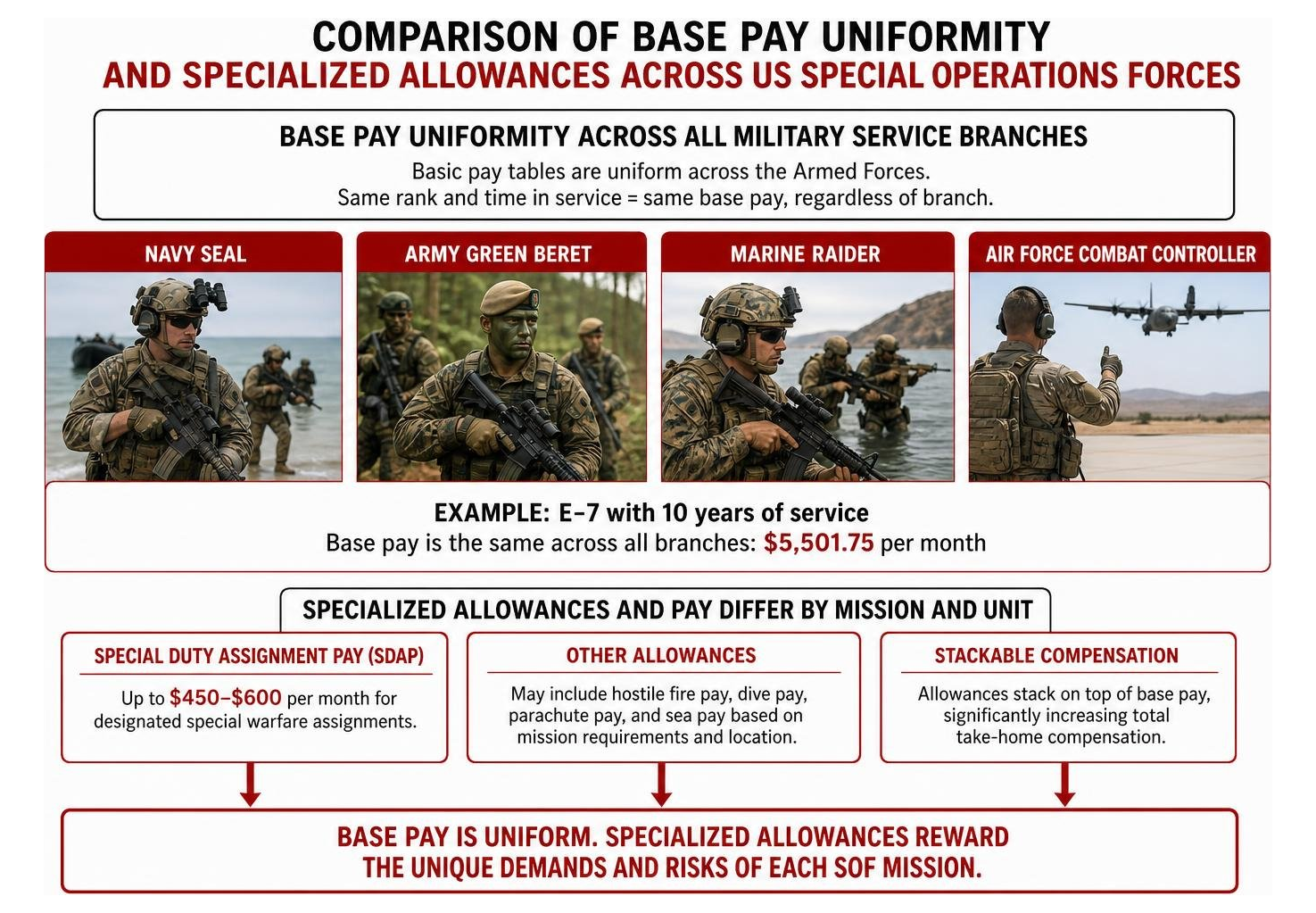
Because basic pay tables remain uniform across the Armed Forces, an E-7 with 10 years of service receives the exact same base pay ($5,501.75/month) whether serving as a Navy SEAL, an Army Green Beret, a Marine Raider, or an Air Force Combat Controller. Direct compensation variations between units are explored in our breakdown of Navy SEALs vs Delta Force pay as well as our review of Ranger compensation.
Analyzing the Navy SEAL Pay Chart 2027 Alongside Special Duty Allowances
While base pay covers essential military rank compensation, active SEAL operators receive multiple stackable allowances and special incentive pay that substantially elevate take-home compensation:
- Special Duty Assignment Pay (SDAP): Up to $450 to $600 monthly for designated special warfare assignments.
- Dive Pay: Maximum hazardous duty dive incentive of $240 to $340 per month depending on qualification.
- Demolition Pay: $150 per month for handling operational explosives.
- Parachute Jump Pay (HALO/Static Line): $150 standard or $225 for Military Free Fall (HALO/HAHO) operations monthly.
- Hostile Fire / Imminent Danger Pay (HFP/IDP): $225 monthly when deployed to designated hostile areas.
- Non-Taxable Allowances: Basic Allowance for Housing (BAH) and Basic Allowance for Subsistence (BAS), which vary by duty location and dependency status.
Frequently Asked Questions About Navy SEAL Pay in 2027
What is the monthly base pay for a Navy SEAL E-5 with 6 years of service in 2027?
Applying the projected 3.8% adjustment to the 2026 baseline rate of $3,923.10 produces an estimated monthly base pay of $4,072.18 for an E-5 with over 6 years of service in 2027. This equates to an annual base salary of roughly $48,866 before adding special duty pay and allowances.
What is the monthly base pay for a Navy SEAL O-3 with 10 years of service in 2027?
A commissioned Lieutenant (O-3) with over 10 years of active-duty service has a projected 2027 basic monthly pay of $9,795.09 (adjusted from the 2026 rate of $9,436.50), generating an annual base pay of approximately $117,541.
How does prior enlisted service impact Navy SEAL officer pay in 2027?
SEALs who complete at least 4 years and 1 day of active-duty enlisted service before earning their commission qualify for O-1E, O-2E, or O-3E pay scales. This status significantly increases base monthly compensation compared to standard junior officer tracks, recognizing previous military leadership and operational experience.
Conclusion
Understanding the financial trajectory of a Naval Special Warfare career requires looking at both standard base pay scales and specialized unit incentives. For comprehensive data regarding current military pay schedules, review our 2026 military pay chart overview as legislative updates develop for 2027.
At USMilitary.com, we are committed to keeping active-duty service members, veterans, and military families informed on pay adjustments, career transitions, VA loan programs, and disability benefits. Plan your financial future proactively by maintaining a clear view of your compensation benchmarks.