
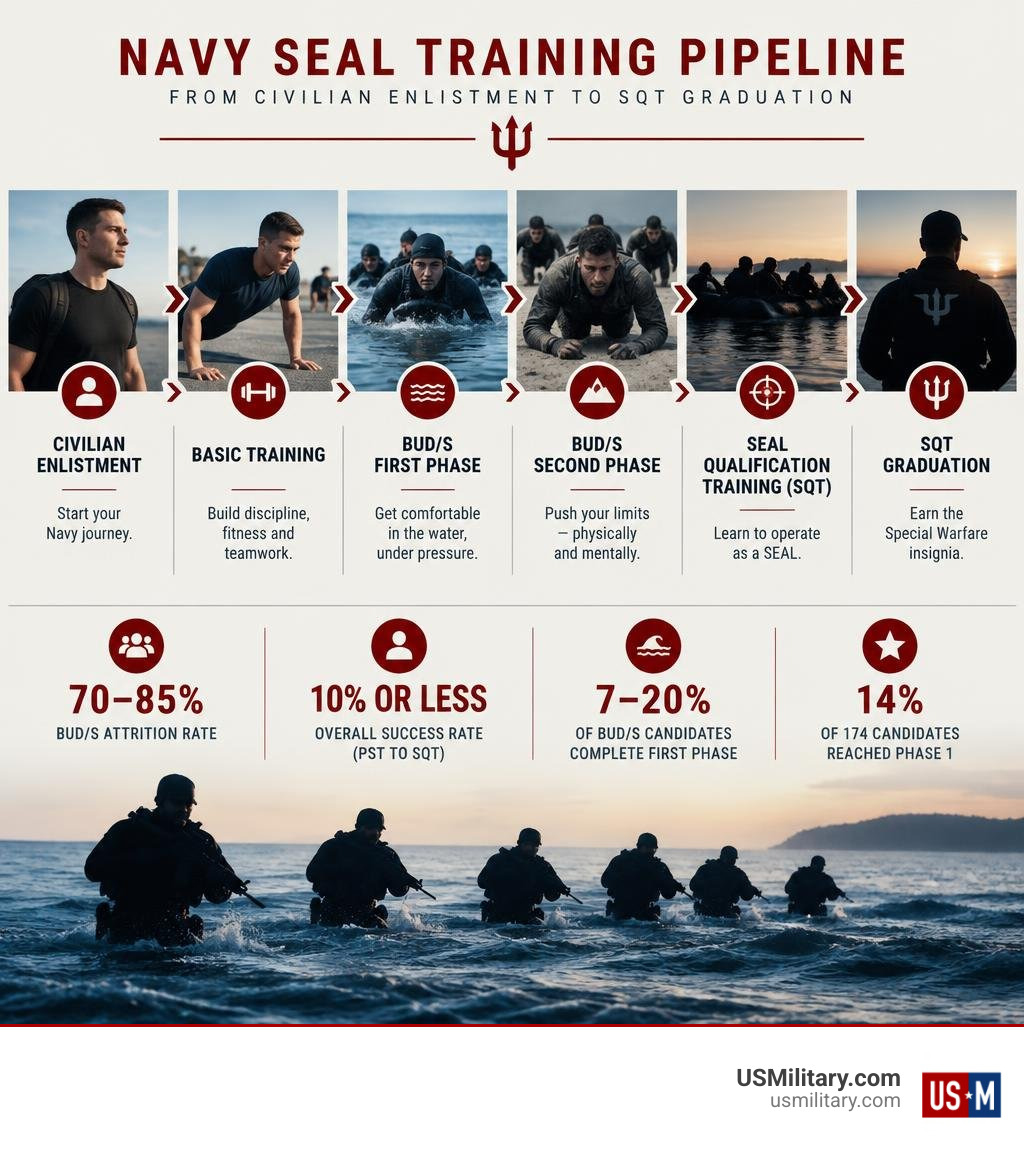
Entering the Naval Special Warfare pipeline requires a reality check backed by hard data. While pop culture focuses on the glory of earning the Trident, the raw metrics tell a sober story: historically, Basic Underwater Demolition/SEAL (BUD/S) attrition hovers between 70% and 85%. Across the entire journey—from the moment you take your first Physical Screening Test (PST) to graduating from SEAL Qualification Training (SQT)—the overall success rate is roughly 10% or less.
In fact, only 7% to 20% of candidates who step foot into BUD/S First Phase ever complete it. In one documented study of 174 candidates, just 25 men (14%) successfully made it through Phase 1, and only 45 managed to reach the start of Hell Week. Knowing the answers to fundamental preparation questions separates those who drop on request (DOR) within seventy-two hours from the small fraction who endure the cold, sand, and sleep deprivation to earn the Special Warfare insignia.
Whether you are weighing high school graduation options or seeking a military career transition as of September 2026, understanding the timeline, the physical benchmarks, and the psychological mechanics of selection is essential before you sign a contract.
10 Must-Ask Questions Before Wanting To Become a Navy SEAL: Selection and Physical Demands
Naval Special Warfare does not suffer from a lack of applicants; it suffers from a lack of prepared applicants. To ensure you stand out among the roughly 1,000 Sailors given the opportunity to attend SEAL training annually, you must understand how candidate vetting works across different entry avenues.
Reviewing the rigorous selection requirements reveals that physical conditioning is merely an entry ticket. The screening process tests your ability to function in high-stress, dynamic marine environments where failure carries strategic consequences.
| Selection Metric | Enlisted Pathway (SO Contract) | Officer Pathway (1130 Designator) |
|---|---|---|
| Annual BUD/S Slots | ~700 to 800 candidates | ~70 to 80 candidates |
| Primary Entry Sources | Civilian Recruiters (Warrior Challenge), Fleet Transfer | USNA, NROTC, Officer Candidate School (OCS) |
| Screening Board | NSW Scout Team & Regional Mentors | NSW Officer Selection Board + SEAL Officer Assessment & Selection (SOAS) |
| Education Requirement | High School Diploma or GED | 4-Year Baccalaureate Degree (minimum) |
| Pre-BUD/S Pipeline | 8–10 Weeks Recruit Training + NSW Prep Course | Commissioning Source + Basic Officer Leadership / SOAS |
| Selection Focus | Operational endurance, trainability, mechanical aptitude | Tactical decision-making under duress, peer leadership, administrative integrity |
10 Must-Ask Questions Before Wanting To Become a Navy SEAL Regarding Timelines and Officer Selection
One of the most frequent misconceptions candidates have is that you can walk into a recruiting station and start BUD/S the following month.
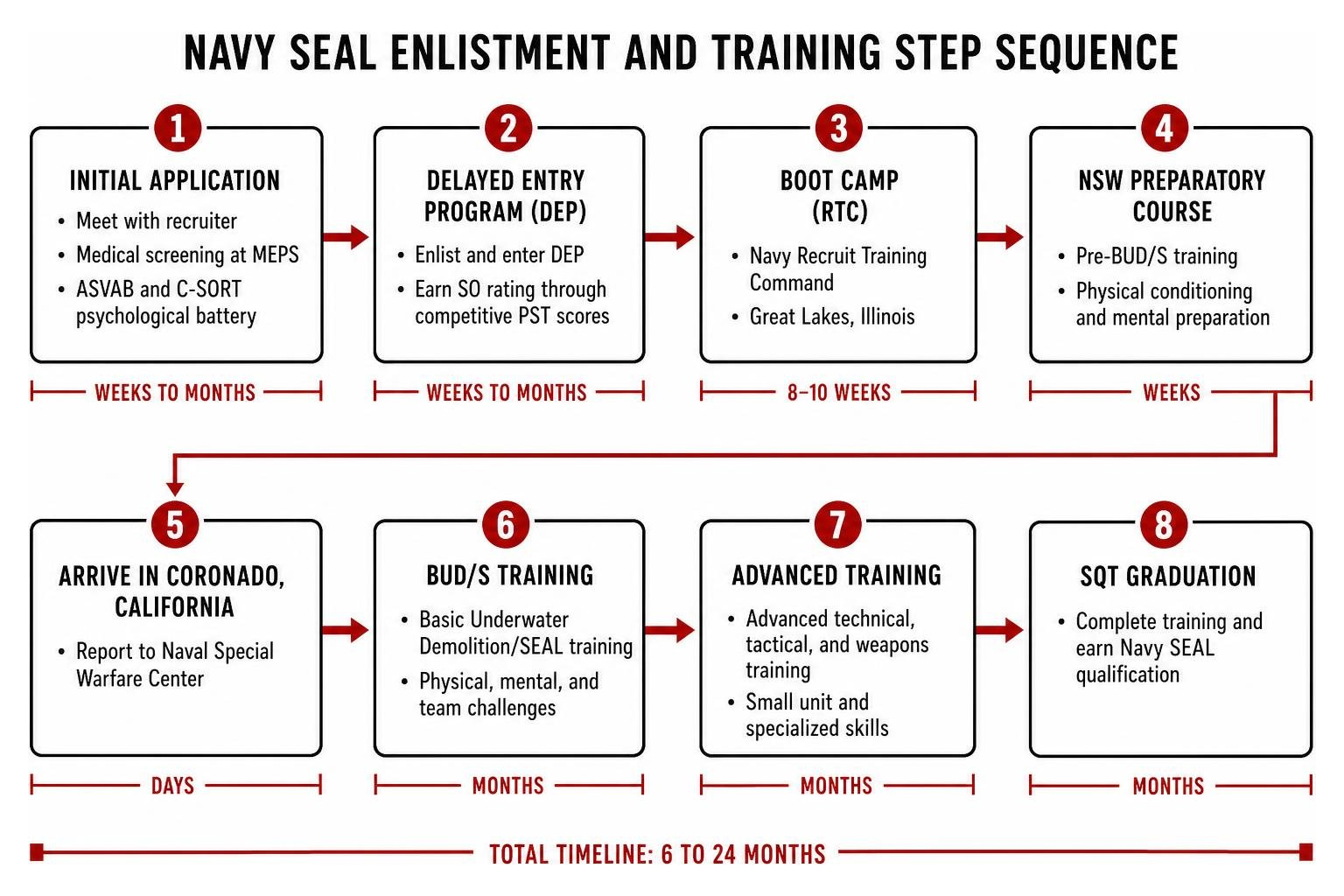
1. What is the realistic timeline from initial application to Day 1 of BUD/S?
The journey spans anywhere from 6 to 24 months. For an enlisted civilian, the process includes meeting a recruiter, completing medical screening at the Military Entrance Processing Station (MEPS), earning a qualifying score on the Armed Services Vocational Aptitude Battery (ASVAB) and the C-SORT psychological battery, entering the Delayed Entry Program (DEP), and earning an SO rating through competitive PST scores. After enlistment, you attend standard Navy Recruit Training Command (Boot Camp) in Great Lakes, Illinois, followed immediately by the Naval Special Warfare Preparatory Course before finally arriving in Coronado, California.
2. How does the officer route differ from the enlisted path?
The officer route is significantly more competitive regarding total available allocations. The Navy selects only 70 to 80 officers for BUD/S each year, compared to roughly 700 to 800 enlisted slots. Officers come through the United States Naval Academy (USNA), Navy Reserve Officer Training Corps (NROTC), or civilian OCS programs. Prospective officers must attend SEAL Officer Assessment and Selection (SOAS), a grueling summer evaluation where their leadership, emotional stability, and physical limits are tested in front of active-duty SEAL leadership. If an officer quits BUD/S, their chances of remaining in special operations are effectively zero, and they are reassigned to the fleet in an unrestricted line role based on the needs of the Navy.
10 Must-Ask Questions Before Wanting To Become a Navy SEAL Concerning Fitness Benchmarks and Simulation
Passing the basic PST gets you a contract; it will not get you through Hell Week. To survive BUD/S, your training must match the specific, high-volume demands of Coronado’s grinder and surf zone.
3. What physical fitness standards must I meet before arriving?
The Navy publishes minimum standards, but successful candidates operate exclusively in the competitive range. Familiarize yourself with the official BUD/S training requirements before starting your regimen.
- 500-Yard Swim (Combat Side Stroke / Breaststroke): Minimum: 12:30 | Competitive: Sub-9:00
- Push-ups (2 minutes): Minimum: 50 | Competitive: 80–100+
- Sit-ups (2 minutes): Minimum: 50 | Competitive: 80–100+
- Pull-ups (Dead hang, no time limit): Minimum: 10 | Competitive: 15–20+
- 1.5-Mile Timed Run (Running shoes): Minimum: 10:30 | Competitive: Sub-9:30
4. What pre-training routines best simulate BUD/S demands?
To endure the physical grinder, focus on three specific areas:
- Fin Swimming: Transition from bare-foot swimming to swimming with stiff, open-heel Scuba fins (such as standard military-issue Rocket Fins). Build up your hip flexors and ankles to swim 2 miles in open water in under 75 minutes.
- Running in Boots on Soft Sand: The vast majority of runs at BUD/S are executed on soft sand in combat boots and utility trousers. Transitioning your connective tissue slowly to this load is vital to avoid shin splints and stress fractures. Aim for a 4-mile timed run in boots in under 28 minutes.
- High-Volume Work Capacity: Incorporate high-repetition bodyweight calisthenics (push-ups, dips, flutter kicks, pull-ups) paired with rucking to build structural stamina for log PT and boat carries.
Psychological Grit: Mental Toughness and Mindset Strategies
Physical fitness gets you to the starting line, but your mind determines whether you make it through the three phases of BUD/S. First Phase tests raw physical conditioning and mental endurance through the crucible of Hell Week (five and a half days of continuous operational training with roughly four hours of total sleep). Second Phase introduces Combat Diving, focusing on underwater composure during pool competency testing. Third Phase moves candidates to San Clemente Island for Land Warfare, weapons handling, and tactical demolitions.
Stress Inoculation and the Stress-Is-Enhancing Advantage
5. How do I develop a stress-is-enhancing mindset?
Stress is often viewed as a toxic state that degrades fine motor control and clouds judgment. However, empirical performance data reveals that candidates who cultivate a "stress-is-enhancing" mindset—viewing the physiological arousal of stress (increased heart rate, heightened focus, adrenaline) as an asset rather than a threat—outperform their peers.
- Candidates with a stress-is-enhancing mindset complete obstacle courses 4.2% faster (roughly 27 seconds quicker) than candidates who view stress as debilitating.
- Candidates viewing stress as an adaptive tool persist 12% longer in high-discomfort training environments before tapping out.
You cultivate this through stress inoculation: purposefully putting yourself into controlled, uncomfortable situations (such as cold-water exposure, intense interval workouts, and complex problem-solving under physical fatigue) and practicing deliberate breath control (such as box breathing: 4-second inhale, 4-second hold, 4-second exhale, 4-second hold).
6. Should I avoid a failure-is-enhancing mindset in this environment?
Yes, within the context of special operations selection, the classic startup concept that "failure is great" must be handled with care. While you must develop the resilience to learn from mistakes quickly, embracing failure as acceptable will lead to immediate removal. In BUD/S, standard performance tests (timed swims, obstacle courses, timed runs, and pool comp) have non-negotiable pass/fail thresholds. If you adopt an attitude that failing a timed test is fine because you "learned something," you will quickly accumulate failure chits and find yourself before a review board. Instead, adopt a growth mindset anchored to flawless execution: focus on micro-goals, correct technical flaws instantly, and demand zero-defect precision under fatigue.
Attrition Realities, Mental Resilience, and Evaluation Systems

7. How important is mental toughness compared to physical fitness?
Both are vital, but their influence peaks at different times. Physical fitness prevents injury and allows you to meet the baseline standards with ease. However, when you are hypothermic, shivering uncontrollably in 55-degree Pacific water at 0300 on Wednesday of Hell Week, physical strength alone will not save you. Understanding mental resilience in training means knowing how to mentally dissociate from physical pain and break immense tasks down into manageable moments—living meal to meal, or evolution to evolution.
8. What are the most common reasons candidates drop out?
The vast majority of candidate losses fall under three primary buckets:
- Drop On Request (DOR): Voluntary withdrawal due to mental fatigue, cold exposure, and homesickness.
- Medical Drops: Stress fractures, severe pneumonia, cellulitis, rhabdomyolysis, or tympanic membrane perforations.
- Performance Drops: Failing to meet cut-off times on the weekly 4-mile timed runs, 2-mile ocean swims, or failing the rigorous safety evolutions of Second Phase Pool Competency.
9. How important are peer and instructor evaluations?
Crucial. Throughout BUD/S, candidates are regularly subjected to peer evaluations where teammates anonymously rank everyone in their boat crew or swim pair. If you are physically elite but act selfishly—skimping on carrying the heavy end of the log, failing to clean weapons, or showing arrogance—your peers will rank you at the bottom. Low peer rankings combined with negative instructor evaluations will prompt a Progress Review Board, which can drop a candidate regardless of their athletic stats.
Mentorship, Enlistment Paths, and Building Your Support Network
Navigating the entry pipeline alone is an unforced error. Naval Special Warfare assigns regional SEAL/SWCC mentors (former operators and senior instructors) to every Navy Recruiting District. These mentors administer official PSTs, evaluate your mental disposition, and sign off on your readiness before you receive an official contract.
10. How do I find a Navy mentor or build a support network?
- Connect with NSW Mentors: Contact a local Navy recruiter and explicitly request a referral to the regional Naval Special Warfare Coordinator or Scout Team Mentor. Attend their weekly or monthly PST clinics.
- Leverage Literature and Realities: Study foundational texts and guides to understand the ethos and culture of the teams before shipping out.
- Build Strong Family Foundations: The pipeline places tremendous strain on personal relationships. Ensure your family, spouse, or support network understands the operational demands, long training rotations, and security protocols of the community. Review our breakdown of the enlisted SEAL pay scale to plan your finances realistically as you enter active duty.
Frequently Asked Questions About Navy SEAL Selection
What is the primary reason candidates drop out during Hell Week?
The overwhelming reason is voluntary withdrawal (DOR) driven by cumulative fatigue, hypothermia, and sleep deprivation. While some candidates suffer medical failures such as bone fractures or fluid in the lungs (SIPE), most who quit simply allow their minds to become overwhelmed by the thought of enduring several more days of cold and exhaustion rather than focusing on the next immediate evolution.
How does having a college degree impact BUD/S completion rates?
Data show that men with two-year or four-year degrees are almost twice as likely to succeed at BUD/S as candidates without a degree. This statistical advantage is primarily linked to age, cognitive maturity, improved emotional regulation under stress, and years of prior structured athletic or academic discipline.
Can civilians enlist directly with a SEAL contract?
Yes. Civilians enter through the Navy Warrior Challenge program. You enlist under a standard contract, work with an NSW mentor in the Delayed Entry Program to pass your PST with competitive scores, and upon qualification, receive an SO (Special Warfare Operator) rating guarantee prior to shipping to boot camp.
Conclusion
Becoming a Navy SEAL is not an outcome of physical talent alone—it is the result of deliberate physical preparation, emotional maturity, and an unwavering commitment made long before arriving in Coronado. By addressing these critical questions early, you give yourself the best possible foundation to not just survive selection, but to thrive within the Teams.
To explore training benchmarks, pipeline breakdowns, and career resources in full detail, explore our complete Navy SEAL career guide. Plan thoroughly, train intelligently, and commit fully to the standard.