
Why a Navy SEAL Officer Career Can Deliver Lifetime Value
The 10 Lifetime Benefits of Becoming a Navy SEAL Officer reach far beyond a paycheck. They include officer base pay and special-duty incentives, tax-advantaged housing and food allowances, 30 days of paid leave, medical and dental coverage, advanced training, a 20-year retirement path, and skills that can support a strong civilian career.
Just as important are the benefits money cannot measure: leading under pressure, serving a mission larger than yourself, traveling and training in demanding environments, and joining a small community built on trust. A SEAL officer does not simply complete tasks. They lead teams through complex decisions where preparation, judgment, and accountability matter.
The trade-off is real. The pipeline is difficult, deployments can separate families, and the work can create lasting physical and mental strain. Anyone considering this path should weigh those costs alongside the rewards, use Navy financial and education programs early, and build a transition plan well before leaving service.
I am Larry Fowler, BUD/S class 89, publisher of NavySeal.com and the USMilitary.com Network since 2007, where I have helped military members and veterans understand service opportunities, VA benefits, and career decisions. In this guide to the 10 Life-Time Benefits of Becoming a Navy SEAL Officer, I will break down what those benefits can mean in practical terms.
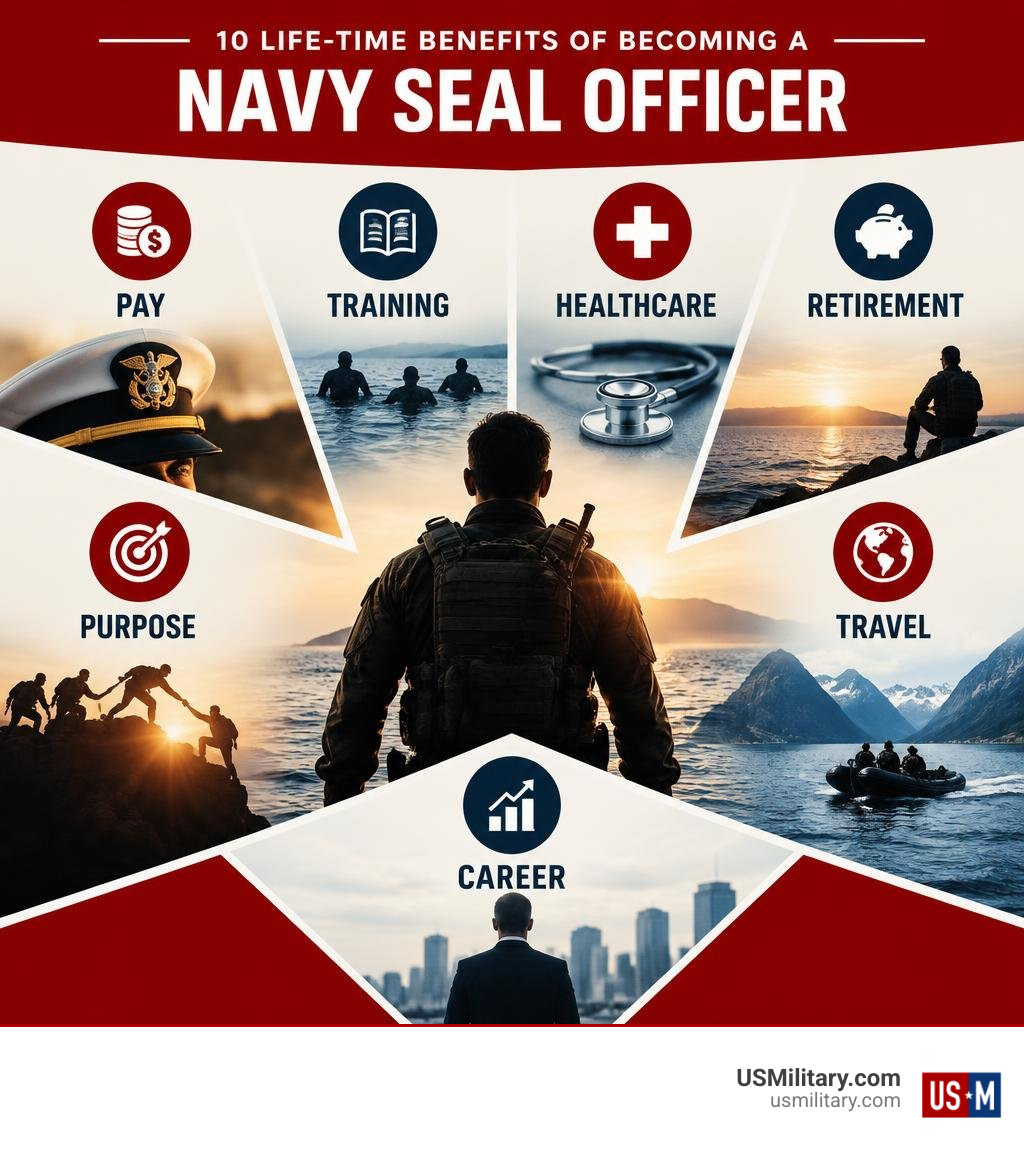
10 Lifetime Benefits of Becoming a Navy SEAL Officer: Vocab to learn:
- Navy SEALs BUD/S Training Requirements
- What is Navy SEAL Training 3 Phases and Why Is It So Tough
- How Much Are Navy SEALs Paid
The Road to the Trident: The SEAL Officer Pipeline
Earning the coveted Special Warfare insignia (the Trident) as a commissioned officer represents one of the most demanding leadership journeys in the United States military. SEAL officers serve under the 1130 designator as Unrestricted Line officers, meaning they are entrusted not merely with executing tactical actions, but with command authority, strategic risk management, and operational leadership across maritime, air, and land domains.
Candidates typically enter the pipeline through three primary commissioning sources: the United States Naval Academy (USNA), Navy Reserve Officer Training Corps (NROTC), or Officer Candidate School (OCS). Regardless of the commissioning path, aspiring officers must first navigate the competitive SEAL Officer Selection process. This involves submitting an exhaustive application package, achieving superior scores on the Physical Screening Test (PST), passing a Down Select Panel, and attending the grueling SEAL Officer Assessment Course (SOAC) held during the summer months.
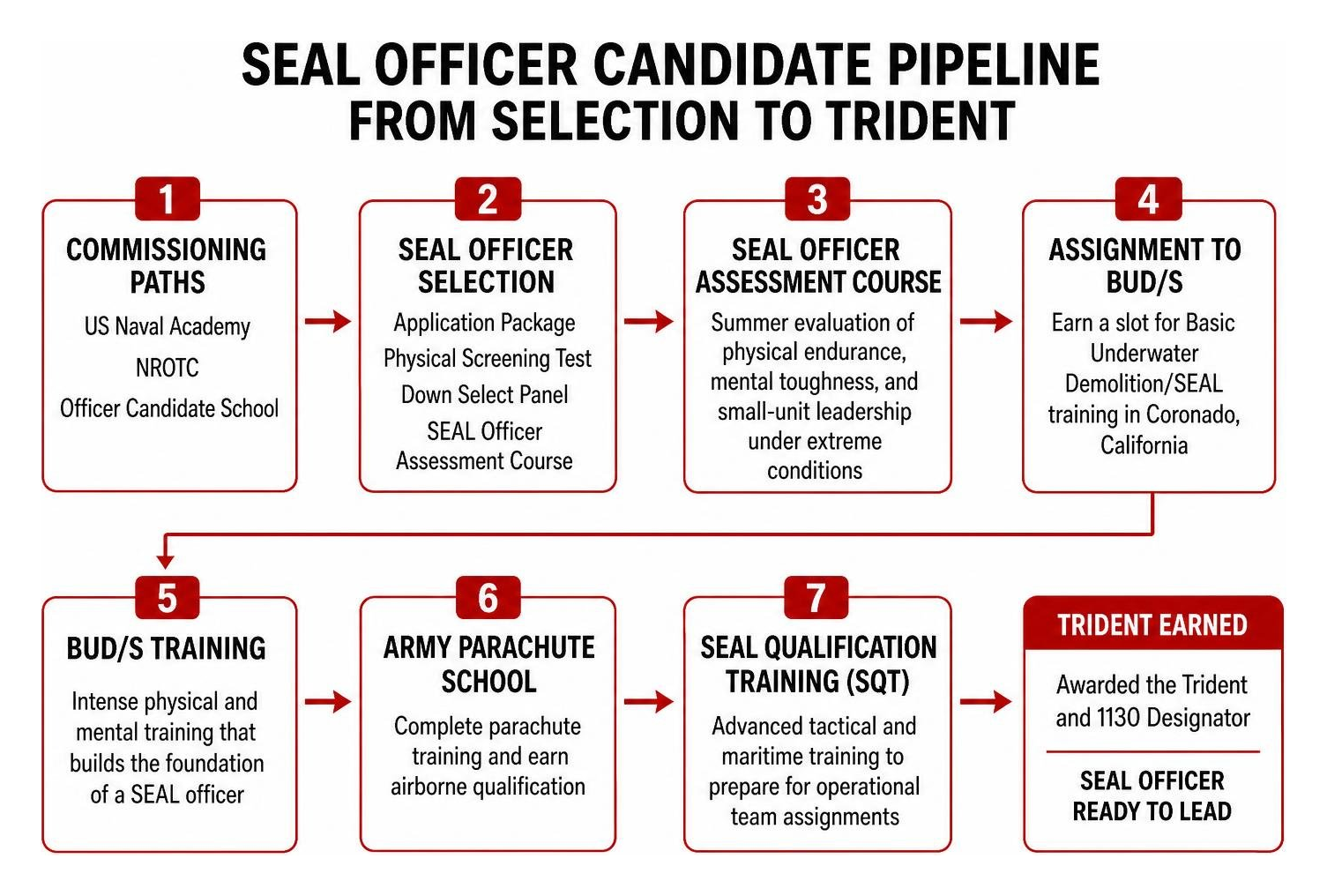
During SOAC, candidates are evaluated on long-distance ocean swims with and without fins, runs exceeding five miles over rough terrain, heavy ruck marches with 35 to 40 pounds of gear, and above all, their capacity for small-unit tactical command under extreme sleep deprivation.
Those selected earn an assignment to Basic Underwater Demolition/SEAL (BUD/S) training in Coronado, California. Meeting the intense Navy SEALs BUDs training requirements requires far more than physical strength—it demands unmatched mental resilience. Following BUD/S, candidates complete Army Parachute School and SEAL Qualification Training (SQT) before being awarded their Trident and 1130 designator, taking their place at the tip of the spear.
10 Life-Time Benefits of Becoming a Navy SEAL Officer

When you choose to lead Special Operators, you unlock advantages that compound over decades. Below is an overview of how active military compensation scales alongside post-service executive potential:
| Career Stage / Category | Military Pay & Allowances (Annual Est.) | Civilian Equivalent Role | Estimated Civilian Total Comp |
|---|---|---|---|
| Junior Officer (O-1 to O-2) | $60,000 – $85,000 + BAH/BAS | Junior Project Manager / Security Analyst | $75,000 – $95,000 |
| Mid-Grade Officer (O-3 to O-4) | $95,000 – $145,000 + Special Pays | Director of Operations / Management Consultant | $140,000 – $195,000 |
| Senior Commander (O-5) | $150,000 – $180,000 + Bonuses | VP of Global Security / Chief Operating Officer | $220,000 – $350,000+ |
| 20-Year Military Retiree (Age 43) | $45,000 – $65,000 Pension + VA Disability (Tax-Free) | Executive Consultant / Defense Tech Executive | $180,000 – $300,000+ Base + Bonus |
Core Financial Advantages: 10 Lifetime Benefits of Becoming a Navy SEAL Officer
1. Elite Military Compensation and Special Incentive Pays
From the moment you commission as an Ensign (O-1), your earnings scale rapidly through the officer pay grades. A commissioned officer's earnings are detailed in our Navy SEAL salary breakdown, starting above $60,000 in direct taxable pay and climbing substantially with rank and time in service. Mid-grade officers (O-3 to O-5) command base pay that reflects their heavy leadership responsibilities.
Beyond standard base pay, SEAL officers receive specialized operational incentives:
- Dive Pay: Up to $240 per month for combat diver qualifications.
- Demolition Pay: $150 per month for handling explosives.
- Parachute Pay: $150 to $250 per month for static-line and Military Free-Fall (HALO/HAHO) jumps.
- Skill Incentive Pay (SkIP) and Naval Special Warfare retention bonuses offering $15,000 to $30,000 annually for maintaining critical warfare qualifications.
To explore all official compensation models and career milestone guides, visit the SEAL Officer Resources portal.
2. Substantial Tax Advantages and Non-Taxable Allowances
A significant portion of a Navy SEAL officer’s income is sheltered from federal and state income taxes. Officers receive non-taxable Basic Allowance for Housing (BAH), customized to their duty station zip code and dependency status, alongside the non-taxable Basic Allowance for Subsistence (BAS).
When deployed forward into designated hazardous duty locations, officers utilize the Combat Zone Tax Exclusion (CZTE). Under CZTE, entire monthly compensation packages can become 100% tax-exempt up to the maximum statutory limit, enabling officers to save and invest tens of thousands of dollars annually without tax friction.
3. Twenty-Year Pension and Lifetime Wealth Accumulation
The military's Blended Retirement System (BRS) pairs automatic and matching Thrift Savings Plan (TSP) contributions (up to 5% of base pay) with a defined-benefit lifetime pension annuity. An officer who retires after 20 years of honorable service at age 42 or 43 receives a lifelong monthly pension starting at 40% to 50% of their highest 36 months of base pay, indexed annually for inflation with Cost of Living Adjustments (COLA).
When combining twenty years of disciplined TSP compound growth, an immediate six-figure civilian second career, lifetime military pension checks, and tax-free VA disability compensation, a retired SEAL officer can easily realize over $17 million in total lifetime financial velocity by age 75.
Elite Leadership and Career Mastery: 10 Lifetime Benefits of Becoming a Navy SEAL Officer

4. World-Class Tactical and Technical Skill Development
SEAL officers undergo continuous advanced education across hundreds of specialized tactical curricula. Officers gain mastery in:
- Combat medic trauma protocols and advanced operational medicine.
- Sniper marksmanship and reconnaissance tradecraft.
- Military Free-Fall Jumpmaster certifications and closed-circuit rebreather diving.
- Full-spectrum foreign language immersion and cross-cultural engagement.
These technical competencies foster razor-sharp analytical capabilities and operational adaptability, elevating your personal skill set well above standard corporate leadership training programs.
5. Executive Decision-Making Under Extreme Stress
A standard corporate manager rarely faces life-or-death decisions with limited intelligence in dynamic environments. A SEAL officer does so routinely. Leading 16-man platoons or multi-agency task forces during complex maritime interdictions instills an elite level of operational risk management. You learn to make high-stakes choices rapidly, take complete accountability for outcomes, and project calm confidence under pressure. This leadership pedigree forms the backbone of the day in the life of a Navy SEAL operator, forging a calm, decisive executive presence that lasts a lifetime.
6. Lifelong Entry into an Exclusive Global Brotherhood
With fewer than 2,500 active-duty Navy SEALs serving worldwide at any given time, the Special Warfare community is one of the most exclusive professional fraternities on earth. The shared adversity of BUD/S Hell Week, rigorous work-ups, and hazardous overseas deployments creates unbreakable bonds. This tight-knit brotherhood follows you long after you take off the uniform, providing an executive network of high-achieving peers, business partners, mentors, and lifelong friends who answer the call whenever needed.
Executive Civilian Transition, Lifelong Healthcare, and National Prestige
7. Rapid Placement into High-Paying Civilian Careers
Corporate recruiters and Fortune 500 boards actively seek out former Special Warfare officers for their integrity, operational agility, and proven leadership. When transitioning to the civilian sector, former SEAL officers seamlessly step into top-tier leadership positions:
- Operations Director / VP of Operations: Median compensation often exceeds $140,000 to $200,000.
- Corporate Security & Risk Executive: Median starting salaries exceed $105,520, with total executive packages passing $250,000.
- Management Consulting & Defense Tech: Earning six-figure salaries or building high-valuation tech and defense startups.
Organizations understand that an officer who successfully led special operations forces in high-consequence environments can master any corporate challenge.
8. Comprehensive Medical, Dental, and Disability Security
Active SEAL officers and their families enjoy top-tier healthcare coverage through TRICARE Prime, with zero out-of-pocket deductibles or copays for military medical care. After retirement, lifetime healthcare options continue through TRICARE for Life, alongside comprehensive VA healthcare programs.
Furthermore, officers who sustain service-connected injuries are eligible for monthly, tax-free VA disability compensation. This provides a guaranteed financial safety net that shields your family from unexpected medical expenses for life.
9. Fully Funded Advanced Education and Wealth Building with VA Loans
SEAL officers earn full Post-9/11 GI Bill education benefits, which cover 100% of in-state public tuition (or generous Yellow Ribbon private tuition rates) plus a monthly housing allowance. Officers who have completed their initial service obligations can often transfer these tuition benefits directly to their children or spouse.
Additionally, officers have lifetime access to the VA Home Loan guarantee program. This federal program allows veterans to purchase real estate with 0% down payment and no private mortgage insurance (PMI), making it easier to build a long-term residential and rental property portfolio.
10. Enduring Personal Purpose, Global Adventure, and National Prestige
Few careers offer the opportunity to defend national security while operating across global expeditionary theaters. Whether conducting underwater reconnaissance, training foreign allied militaries, or executing direct-action operations against hostile networks, SEAL officers experience profound, purposeful work.
The personal pride, global travel, and prestige that come with earning and wearing the Navy SEAL Trident stay with you forever. As highlighted in guides detailing 8 Navy SEAL benefits, the respect earned by serving as a Frogman commands immediate credibility across civilian and professional sectors worldwide.
Navigating the Trade-Offs: Why the Rewards Outweigh the Sacrifices
A realistic perspective on the Special Warfare community requires acknowledging the physical and personal toll of the job. The high operational tempo involves arduous training cycles, 6- to 7-month overseas deployments, and extended periods away from loved ones.
The physical demands of constant load carriage, fast-roping, diving, and tactical maneuvers inevitably cause musculoskeletal wear and tear. Furthermore, the operational risks are real.
When evaluating career paths—such as comparing Navy SEALs vs Delta Force pay and service lifestyles—prospective candidates must recognize that this career requires dedication, personal discipline, and family resilience. However, for those who answer the call, the combination of lifelong financial security, an elite executive mindset, unmatched camaraderie, and the honor of serving our nation makes the sacrifices well worth the investment.
Frequently Asked Questions About Navy SEAL Officer Benefits
How does officer pay compare to enlisted SEAL compensation?
Commissioned officers receive higher basic pay scales than enlisted personnel across all pay grades. While an entry-level enlisted operator (E-4 to E-5) earns strong specialty pays and reenlistment incentives—as outlined in our review of enlisted Navy SEAL salary in 2026—a junior officer (O-1 to O-3) receives higher base pay and officer housing allowances (BAH). Both groups receive the same dive, jump, and demolition special pays, but officer compensation reflects their broader legal command authority and tactical planning responsibilities.
Can a Navy SEAL officer achieve financial independence retiring after 20 years?
Yes. Retiring at age 42 or 43 with a 20-year pension secures a guaranteed monthly income floor that covers baseline living expenses for life. When paired with tax-free VA disability compensation, robust TSP investment growth, zero-down VA home loans, and immediate executive civilian earning power, retired SEAL officers frequently achieve complete financial independence within just a few years of leaving active duty.
What advanced educational opportunities are available to active SEAL officers?
Active-duty SEAL officers can pursue fully funded graduate degrees through the Naval Postgraduate School (NPS), the Naval War College, or prestigious civilian universities via elite military fellowship programs. Through the SEAL Officer Education Screening Panel, officers are regularly selected to earn master's degrees in national security affairs, strategic studies, business administration, and operational analysis with full tuition coverage and regular pay.
Conclusion
Becoming a Navy SEAL Officer is far more than a military assignment—it is a life-shaping journey that builds generational wealth, executive leadership mastery, and an elite personal legacy. The skills, brotherhood, and financial benefits you earn under the Trident will continue serving you and your family for the rest of your life.
Ready to discover everything it takes to earn the Trident and lead special operations teams? Explore our comprehensive Navy SEAL career guide to launch your special operations journey today.