Why Some Civilian Jobs Clash With the Navy SEAL Mindset
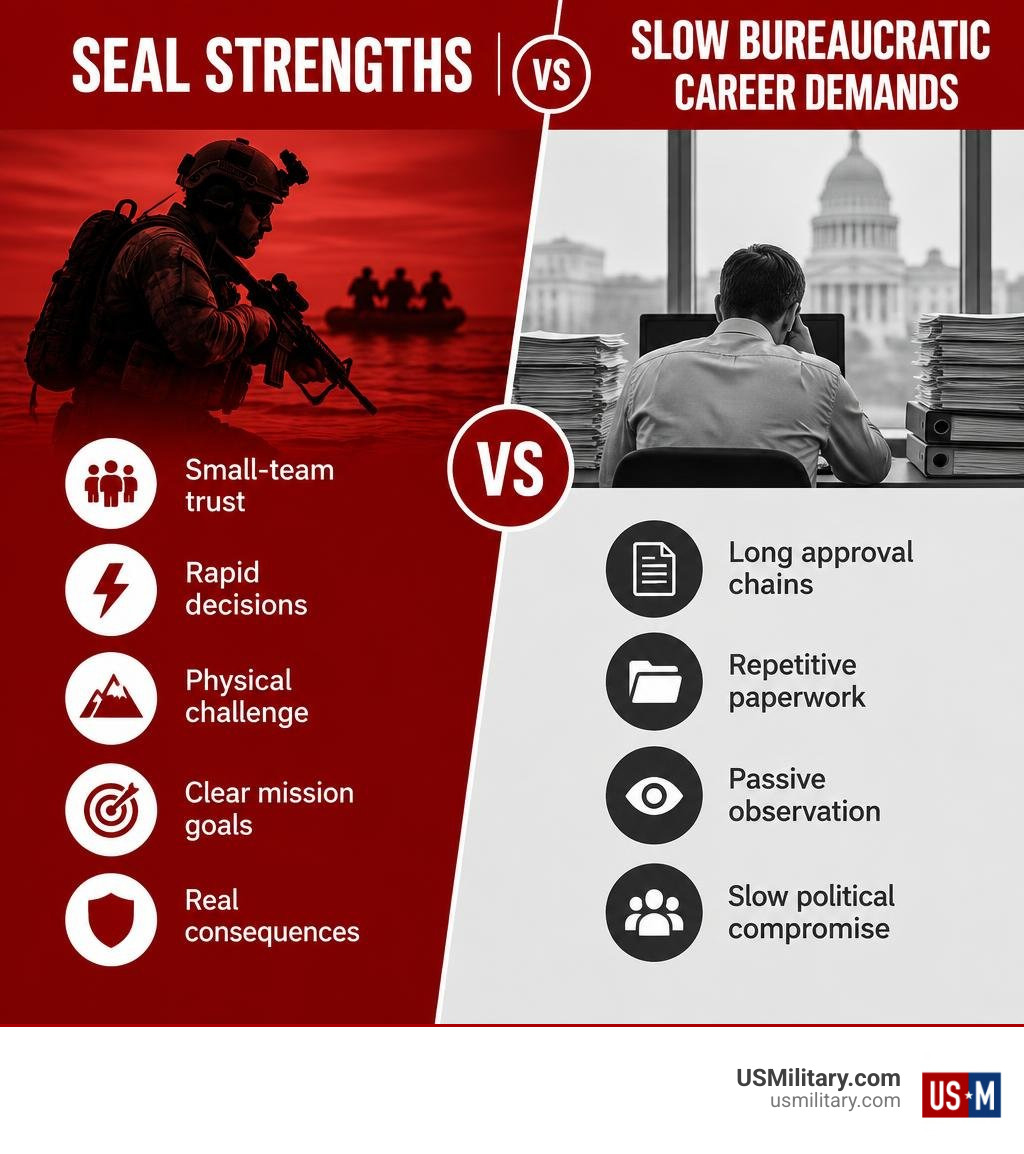
The premise behind 7 Jobs No Navy SEAL Could Ever Do In His Lifetime is not that SEALs lack intelligence or discipline. It is that some jobs demand the opposite of what special operations training rewards: long approval chains, repetitive paperwork, passive observation, and slow political compromise.
The seven roles ahead are deliberately extreme examples, including zoning administration, conservation-easement monitoring, compliance auditing, repetitive inspection, water-district bureaucracy, archival clerking, and academic committee work. A former SEAL could technically qualify for many of them. But the fit may be poor when a person is used to small-team trust, rapid decisions, physical challenge, clear mission goals, and real consequences.
That does not mean veterans cannot thrive in government or corporate work. In a crisis, a SEAL's calm leadership and planning can be valuable to a city manager, flood board, or public agency. The harder part is accepting that good local government often requires public hearings, legal process, patient listening, and compromise before action.
I am Larry Fowler, BUD/s Class 89, publisher of NavySeal.com and the USMilitary.com Network since 2007, where I have helped connect service members and veterans with practical information on military careers, benefits, and transition choices. In examining 7 Jobs No Navy SEAL Could Ever Do In His Lifetime, the goal is to separate a humorous premise from the real question: which careers best match a veteran's strengths, goals, and preferred pace of work?
Simple 7 Jobs No Navy SEAL Could Ever Do In His Lifetime word guide:
- A Day In The Life Of A Navy SEAL Operator
- What Navy SEAL BUD/S Training Taught Me About Self-Confidence, Courage, & Faith
- Navy SEALs BUD/S Training Requirements
The SEAL Mindset: Why Extreme Bureaucracy Clashes With Special Operations

To understand why certain civilian roles represent pure psychological torture for a special warfare operator, we have to look closely at the conditioning pipeline. Basic Underwater Demolition/SEAL (BUD/S) training is deliberately engineered to strip away self-preservation instincts and replace them with high operational tempo, extreme accountability, and immediate problem-solving. Meeting the rigorous physical conditioning during BUD/S demands that a candidate learn to operate in chaotic, high-stakes environments where hesitation leads to absolute mission failure.
During their pipeline, operators must endure intense physiological stress, ranging from hypothermia to combat dive conditions that risk serious medical conditions, such as those analyzed in a clinical study on immersion pulmonary edema in combat divers. This forge produces professionals who rely on decentralized command, intuitive communication, and absolute personal responsibility.
When an operator completes a task, the objective is binary: success or failure. There is no gray area, no room for political back-scratching, and no 14-month review board to decide whether to take cover from incoming fire. When you place a professional built on direct action into a career defined by static paperwork and multi-layered red tape, friction is inevitable.
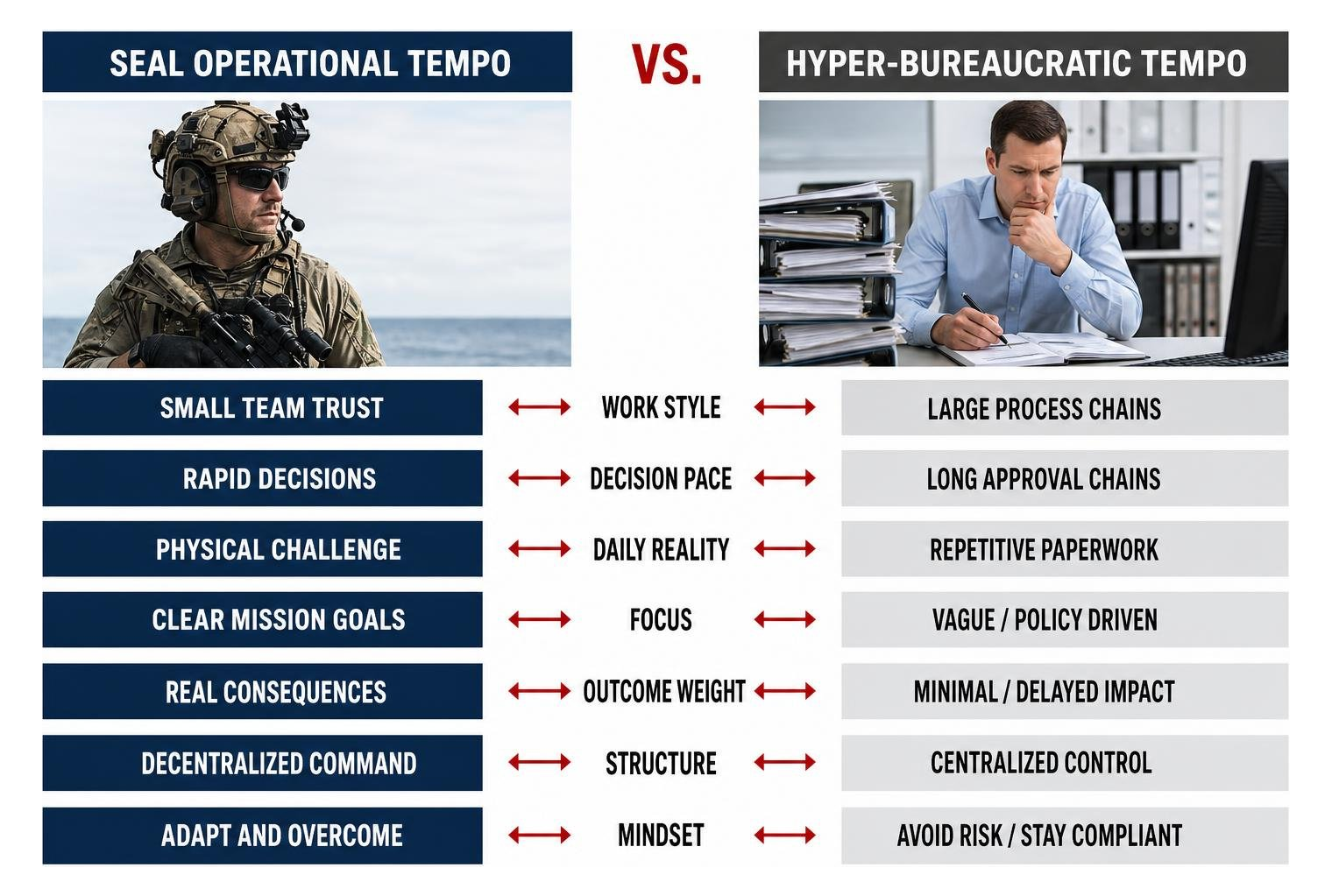
Why These 7 Jobs No Navy SEAL Could Ever Do In His Lifetime Conflict With BUD/S Conditioning
The six months of BUD/S weed out roughly 70% to 85% of hopefuls, leaving a select group defined by decisive bias and extreme mental resilience. Discovering what BUD/S teaches about personal growth reveals that elite operators are conditioned to aggressively solve problems the moment they appear.
In contrast, hyper-bureaucratic civilian environments are specifically engineered around risk aversion and consensus paralysis. The core traits clash fundamentally:
- Decisive Action vs. Deliberative Delay: SEALs are trained to seize the initiative; bureaucratic institutions exist to slow down decisions to minimize liability.
- Radical Accountability vs. Distributed Responsibility: In a SEAL platoon, mistakes are owned immediately in debriefs; in procedural desk jobs, errors are buried under committee memos.
- Direct Communication vs. Political Diplomatic Jargon: Operators use concise, unvarnished communication to preserve lives; bureaucratic environments rely on ambiguous, soft language to avoid offending stakeholders.
7 Jobs No Navy SEAL Could Ever Do In His Lifetime
While former operators have excelled in dynamic civilian fields—from founding major defense companies to mastering enterprise sales—certain professions remain diametrically opposed to the operator's DNA. Here is our breakdown of the civilian roles that would push any veteran frogman to the brink of pure existential dread.
| Metric | High-Tempo Special Operations Environment | Bureaucratic Civilian Roles |
|---|---|---|
| Pace of Decision-Making | Seconds to minutes | Months to years |
| Primary Incentive | Mission accomplishment & team survival | Risk mitigation & regulatory adherence |
| Command Structure | Flat, decentralized, high autonomy | Hierarchical, siloed, low autonomy |
| Tolerated Ambiguity | Tactical initiative encouraged | Strict procedural compliance required |
| Accountability Standard | Immediate, direct post-mission debriefs | Distributed liability via committees |
1. Municipal Zoning Administrator and Planning Board Member
Imagine trading a tactical night infiltration for a four-hour municipal public hearing regarding a 6-inch setback variance for an accessory dwelling unit.
A municipal zoning administrator must navigate the labyrinth of municipal land-use ordinances, short-term rental overlays, conditional use permits, and historic preservation guidelines. Rather than executing a high-stakes mission, this role requires managing agitated neighborhood coalitions arguing over driveway easements and curb cuts.
Decisions in this environment do not hinge on objective efficiency or tactical logic. Instead, they require exhaustive adherence to public notification laws, administrative appeals, and standard political maneuvering. Even when examining federal standards, such as historic military authorization standards, procedural reviews take years. For a professional accustomed to executing direct-action hits under crushing deadlines, spending months listening to public commentary on drainage retention ponds represents a unique brand of mental agony.
2. Long-Term Passive Conservation Easement Inspector
A conservation easement inspector spends years monitoring agricultural preservation parcels, such as those governed by an Agricultural Reserve Program. The core responsibility involves visiting rural properties on an annual cycle to confirm that a property owner has not altered a ditch, constructed an unauthorized pole barn, or violated a 25-year static deed restriction.
The operational reality of this career is defined entirely by the total absence of urgency:
- Driving across rural properties with a clipboard to take photos of fence lines.
- Filing annual compliance memos into a municipal or state database.
- Waiting months for legal teams to issue a non-binding notice of corrective action if an infraction occurs.
For a warrior trained to operate at the peak of physical readiness and tactical aggression, measuring the 20-year vegetative growth along a passive drainage ditch provides zero adrenaline and zero tangible execution.
3. Corporate Bureaucracy Regulatory Compliance Auditor
In the corporate world, few positions embody paralysis quite like the enterprise regulatory compliance auditor. This position exists solely to minimize legal and regulatory liability for massive corporate conglomerates by enforcing internal paperwork checklists.
Rather than moving fast and breaking obstacles, the compliance auditor's entire job is to slow operations down. Every initiative must be cross-checked against internal policies, corporate governance frameworks, and government reporting standards.
When a SEAL sees an administrative bottleneck, the instinct is to eliminate it to achieve the objective. In regulatory compliance, however, the bottleneck is the objective. Operating in an environment where people actively generate red tape to justify their own employment is the polar opposite of small-unit warfare.
4. Monotonous Assembly-Line Repetitive Quality Inspector
Surviving the unrelenting demands of elite military training produces high cognitive adaptability and sharp situational awareness under dynamic conditions.
Placing that same mind on a stationary industrial assembly line to inspect microchip solder points or cosmetic defects on plastic bottles for eight hours a day creates intense cognitive under-stimulation.
In repetitive inspection roles, deviation from strict mechanical repetition is penalized. Operators thrive when they can read the battlefield, adapt to shifting conditions, and apply creative tactical solutions. Forcing a combat veteran into stationary physical isolation with zero operational stakes quickly leads to severe burnout.
5. Municipal Water District SCADA and Rate Study Bureaucrat
Municipal utilities manage critical infrastructure through structured public board meetings, detailed consent calendars, and multi-year rate studies. A utility administrative analyst spends months compiling data on Supervisory Control and Data Acquisition (SCADA) support agreements, leak detection reports, and regional water supply diversification studies.
Consider the reality of this workflow:
- Reviewing multi-hundred-thousand-dollar consultant contracts over several quarters.
- Generating 400-page agenda packets for monthly board approvals.
- Engaging in circular public hearings regarding fractional increases in residential water tier rates.
In special warfare, when vital resources are needed, logistics channels adapt rapidly to support frontline operators. In a utility district, funding an essential piece of hardware requires endless committee reviews, request-for-proposal cycles, and public hearings that crawl along at a glacial pace.
6. Solitary Archival Document Clerk
Team culture is the cornerstone of Naval Special Warfare. The operational intimacy, trust, and cohesion found in small units, such as the tactical team cohesion modeled in Navy SEAL Team 4, represent the pinnacle of collaborative performance.
A solitary archival document clerk, on the other hand, works in complete physical and social isolation. The workday involves cataloging microfilm, indexing centuries-old paper deeds, binding municipal records, and archiving digital files in quiet, temperature-controlled basements.
There are no teammates watching your six, no shared victories, and no dynamic physical challenges. For an individual whose entire professional identity was forged through shared hardship in freezing ocean waters, solitary document clerking feels less like a civilian career and more like administrative solitary confinement.
7. Pure Theoretical Academic Committee Arbitrator
University administrative politics are famous for being uniquely vicious precisely because the practical stakes are so low. A theoretical academic committee arbitrator spends working hours moderating theoretical disputes between academic departments over curriculum wording, faculty senate seating, or multi-year tenure review guidelines.
In this environment:
- Arguments persist indefinitely without any real-world operational consequence.
- Consensus-building is endless, and definitive decisions are constantly deferred.
- Rhetoric, political maneuvering, and intellectual posturing replace practical execution.
When we evaluate the operational demands compared to other elite special forces, special operators rely on objective debriefs: what worked, what failed, and how to improve before the next sunrise. Sitting through hours of circular, theoretical debate without an actionable outcome goes against every operational principle a SEAL possesses.
Where SEAL Leadership Excels vs. Where It Fails in Local Governance
The unique traits of Navy SEALs create immense value in specific civilian leadership contexts, but they can backfire if applied without modification in civilian governance.
Examining congressional findings on defense leadership and authorization illustrates how military command structures differ from civilian governance. In high-threat crisis management—such as leading an emergency operations center during a catastrophic hurricane, restructuring a failing supply network, or heading executive crisis operations—a SEAL's ability to maintain composure, prioritize tasks, and execute decentralized command is unmatched.
However, in standard municipal governance, direct-action leadership often clashes with the democratic process. A City Manager or Flood Prevention Board Chair cannot simply issue tactical orders to community members or unilaterally reallocate municipal budgets. Civilian governance requires:
- Building slow political consensus among opposing constituent groups.
- Respecting mandatory public notice periods, environmental reviews, and state sunshine laws.
- Accepting that the most legally and politically viable solution is rarely the fastest or most efficient one.
When special operators recognize these structural differences, they can channel their decisiveness into roles where immediate executive action is an asset rather than a procedural liability.
Key Takeaways: Lessons From the 7 Jobs No Navy SEAL Could Ever Do In His Lifetime
Looking at these extreme mismatches highlights essential principles for any veteran planning their post-service career:
- Identify the Pace: Match your career choice with your preferred operational tempo. High-tempo veterans naturally excel in fast-moving fields like executive protection, crisis consulting, and entrepreneurship, as detailed in career studies from NavySEAL.com and veteran transition roadmaps from the Military Transition Toolkit.
- Seek Shared Accountability: Look for workplace cultures that prioritize clear mission outcomes over distributed bureaucratic blame.
- Embrace Realistic Skill Translation: Recognize that civilian institutions move deliberately by design to protect civil liberties and manage public funds. Learn when to lead decisively and when to let procedural processes run their course.
Frequently Asked Questions About SEAL Career Transitions
What civilian jobs are best suited for former Navy SEALs?
Former SEALs thrive in dynamic, mission-focused environments that reward calculated risk-taking, leadership under pressure, and autonomy. Top civilian career paths include federal law enforcement (FBI, DEA, US Marshals), high-threat executive protection, private security contracting, technical sales, entrepreneurship, and corporate leadership consulting. To understand the transition from military pay scales to civilian earnings, check out our guide on comprehensive military salary and compensation dynamics.
Could a Navy SEAL serve effectively as a City Manager or Mayor?
Yes, provided they adapt their leadership style to the realities of local government. While a former operator brings exceptional crisis management, integrity, and strategic planning skills to municipal administration, they must also embrace the patient, public consensus-building required to manage city councils, public works boards, and diverse community stakeholders.
Why do hyper-structured bureaucratic environments frustrate special operations veterans?
Special operations culture relies heavily on decentralized command—empowering individuals on the ground to make immediate decisions based on real-time conditions. Hyper-structured bureaucratic environments operate on the opposite principle: centralizing decisions, requiring multiple layers of sign-off, and prioritizing risk aversion over speed. This deliberate delay can feel deeply inefficient and counterproductive to a combat veteran.
Conclusion
Understanding why certain careers are fundamentally incompatible with special warfare veterans is not an insult to those professions. Rather, it highlights the importance of aligning an individual's psychological conditioning, training, and core values with the demands of their civilian workplace.
The mindset that keeps an operator alive in extreme combat—rapid decision-making, direct communication, and a refusal to accept failure—is simply wasted in careers built on static paperwork and procedural stagnation. By understanding these strengths, transitioning service members can bypass dead-end roles and build impactful, mission-driven civilian careers.
At USMilitary.com, we are dedicated to providing active-duty personnel, veterans, and military families with the guidance they need to navigate service life, VA benefits, and career transitions. For deeper insights into Naval Special Warfare paths and requirements, explore our comprehensive guide to Navy SEAL careers and service.